The Victorian Smiths changed in their naming habits between March 1840 and Dec 1909. Though Mary stayed steadfast at the top throughout most of the Victorian era, by Edwardian times it had been overtaken by Florence, with Doris snipping at its heels.
The number of girls given the top names also decreased - Mary's best period was 1860-4 when 3248 Smiths were named Mary. By 1905, the top name, Florence, charted merely 1250 births. This is an even bigger decrease when you look at the population statistics for England in that time. In 1861, the population of England was almost 18.8 million, by 1901 it was 30.5 million and in 1911 it was 33.6 million. This population growth did not come merely from immigrants - born elsewhere so that their birth and name records would not be counted - it came from more children surviving infancy and so breeding more children to survive infancy - an improvement in healthcare and sanitation, without contraception.
However, I understand that the birth records take into account the births of children who never reached maturity (eg died age 2) and so does not exactly correlate with the population growth (and I think my data also included Scotland and Wales). However, the change is shown over the generations - if one generation has five children (all baptised, all included in my data) but two die before having children of their own, and then the three go on to have five children each then I will note twenty names overall. But if none of the children die, and they all have five children then that gives thirty names overall. So there should be some effect on the names.
Basically, the reduction of Mary (and the top names' in general) popularity from 3000 births to 1000 births is even more dramatic considering that there should be more births.
Anyway, onto graphs. I wanted to see if names that peaked in the same decades had the same arcs of popularity. I think that the graphs speak for themselves.
1840s: Maria (blue), Jane (red) and Caroline (green).
1850s: Eliza (dark blue, diamonds), Hannah (red), Martha (green), Emma (purple) and Harriet (light blue, stars)
1860s: Mary (blue), Elizabeth (red), Sarah (green) and Fanny (purple).
1870s: Emily (dark blue, diamonds), Louisa (red, squares), Catherine (green, triangles), Charlotte (purple, x), Isabella (light blue, star), Ann (orange, circle), Alice (light blue, line), Ada (red, straight), Margaret (green, straight), Clara (purple, diamond), Kate (light blue, square), Frances (orange, triangle), Lucy (light blue, cross), Isabel (pink, cross) and Eleanor (light green, circle).
1880s: Ellen (dark blue), Rosa (red), Ruth (green), Beatrice (purple), Maud (light blue) and Bertha (orange).
1890s: Annie (dark blue, diamond), Ethel (red, square), Mabel (green, triangle), Daisy (purple), Florence (light blue, star), Edith (orange), Elsie (light blue, line), Lily (pink) and Nell (green). Eh, ok something to point out - they all start from nothing.
1900s: Dorothy (dark blue, diamond), Rose (red), May (green, triangle), Jessie (purple, cross), Doris (light blue, star), Gladys (orange), Winifred (light blue, line), Hilda (pink), Ivy (green, straight), Violet (purple, diamond) and Olive (light blue, square). Like 1890s, these come from nothing to their dizzy heights of popularity.
Saturday, September 13, 2008
The Victorian Smiths - an overview
Thursday, September 04, 2008
The Victorian Smiths in the 1890s
1890-4:
What this is all about. Data.
Top 10:
| 1 | Mary |
| 2 | Ann |
| 3 | Florence |
| 4 | Annie |
| 5 | Elizabeth |
| 6 | Edith |
| 7 | Alice |
| 8 | Ethel |
| 9 | Sarah |
| 10 | Elsie |
Lots of change here. The previous top 4 had Elizabeth and Alice as 3 and 4. These have now been pushed down to 5 and 7 - replaced with Florence (from 5) and Annie (from 7) - a swap. Ethel has entered the top 10 at #8, as has Elsie at #10. Sarah has fallen from 6 to 9, and Ellen and Emily have left the top 10 - though E is still the most popular letter.
A few peakers this time: Annie, Ethel, Mabel and Daisy - a manageable amount to go through. I have reacquired Withycombe from the library, and so can again consult that book's wisdom.
Annie is instantly recognisable as a nickname or diminutive - of Ann (the oxymoron being that Annie - the nickname of Ann - is actually longer than the name it is nicknaming) or of Anna or other 'An-' names. It doesn't really seem to be used independently as a name until the 19th century, and does fall in with the 'nickname' trend of the time - along with Elsie, Nell, Jessie, Kate and Fanny. As Annie has had the most popular thus far of any of the 'nicknames', it can be considered the most 'successful' - Ann (and Anna) are popular names, and unlike Elizabeth - where there are many nicknames - Annie is the easiest and most obvious of the Ann nicknames and so the most commonly used- coupled with the popularity of Ann, making it popular. (A note on Anna - as it is only one letter off Ann, I believe that it was counted, along with Anne, on the BMD counts and that is why it is not noted in these lists - so the popularity of Ann may have increased due to the inclusion of Anna). A few books (Pickering's Penguin Dictionary, in particular) link Annie's 19th century popularity to the Scottish song 'Annie Laurie' popularised in the 1830s. The modern association of the red-headed orphan Annie originated with the 'Little Orphan Annie' comic strips, started in 1924 (though the concept for the title came from the 1885 poem 'Little Orphant Annie'. Another 19th century association is social reformer Annie Besant (b. 1847).
Ethel is a name that is rather maligned in 2008 - a grandmother name on par with Gertrude and Bertha, that hasn't yet reached that vintage chic that Edith now seems to embody. Ethel is indeed a dimunitive - of all those great Angl0-Saxon Ethel-/Aethel- names eg Æthelthryth, Æthelswith, Ethelfleda and Æthelgiva. A little OTT, even for the Victorian Anglo-Saxon revival. I can also (and this is mere speculation) see Ethel as an alternative to Elizabeth. Anyway, it was used several times in literature in the mid-19th century - by Thackeray in The Newcomes (1855) and CM Yonge's The Daisy Chain (1856). Yonge went on to write History of Christian Names in 1884, though she barely mentions Ethel.
Mabel is next. A Medieval name that was never exceedingly popular in Medieval times, that Withycombe states had a resurgence in the late 19th century - as seen here. Once pronounced to rhyme with 'gabble', but now to rhyme with 'able'. Borne by illustrator Mabel Lucie Attwell (b. 1879). Annie Besant, named earlier, also called her daughter Mabel.
Daisy - part of the late Victorian flower name trend. Also helped by the fact that it is a nickname for Margaret (marguerite being French for Daisy). Dunkling and Gosling also state that 'daisy' was a late Victorian nickname for an 'excellent person or thing' - certainly not something that would discourage use of the name. The song 'Daisy bell' was written in 1892, at the height of Daisy's popularity. Daisy Miller - a novella by Henry James, of which Daisy is the heroine, was written in 1878, and was an immediate and popular success.
1895-9:
| 1 | Florence |
| 2 | Mary |
| 3 | Ann |
| 4 | Annie |
| 5 | Edith |
| 6 | Alice |
| 7 | Elizabeth |
| 8 | Elsie |
| 9 | Ethel |
| 10 | Dorothy |
First, this list appears groundbreaking - Mary has been replaced at the top by Florence. But...looking at the data, Mary and Florence actually share the top spot - both having 1497 births, Florence is earlier in the alphabet so comes first. Anyway, Florence is extremely popular and has risen from #3. Mary has also fallen from it's untouchable spot in the mid-1850s where it had over 3000 births, down to merely 1500. Elizabeth has slipped down to #7 from #5, and is now far from her #2 and 3 spot held until 1890 - quite a fast fall. Edith and Alice are both pushed up by Elizabeth's fall. Elsie is up to #8 and Ethel is already falling, down to #9. Dorothy is a new entry at #10 (from #12) and Sarah has departed from the top 10, for the first time, to #16.
Quite a few peakers for this period: Florence, Edith, Elsie, Lily, Nell and Victoria.
Florence was really the anme that started this whole study for me - I had known that it was popular in the late Victorian period, but I had wanted to know HOW popular, and to compare it with names like Mary, Elizabeth, nicknames like Annie and Elsie, Anglo-Saxon revivals such as Edith and Ethel, and florals like Daisy and Lily. The most famous Florence, and the woman to whom it's popularity is attributed, is Florence Nightingale - the 'Lady with the Lamp'. Prior to her, it is fairly uncommon: see below:
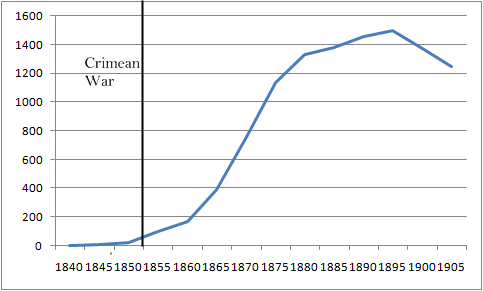 Nightingale became famous during the Crimean war - 1854-6. I had, prior to this research, assumed that Florence had become popular very, very quickly after the war, but this graph shows that the growth in popularity was quite gradual. Aside from Nightingale, Florence had been used by some as the Anglicised form of the Irish name Finian - as in Florence MacCarthy.
Edith is a name that is experiencing a revival in the UK at the moment - it has a certain 'vintage chic', mainly aided by it's nickname Edie. An Anglo-Saxon name, like Ethel though actually used then. Edith survived into the Middle Ages, but was gradually phased out from the 16th to 18th century. It appears on only one of Redmonds' lists - 1538-49 at #10. It experienced a revival in the 19th century as part of the trend for Anglo-Saxon names. The majority of its bearers had their accomplishmeents after the Victorian period, but Edith (E.) Nesbit (b. 1858) published 'The Story of the Treasure-Seekers' in 1898/9 and (probably her most famous work) 'The Railway Children' in 1906.
Elsie is a nickname for Elizabeth from the Scottish name Elspeth (Elisabeth-Elspeth-Elspie-Elsie). Dunkling and Gosling state that it has been used independently since the 18th century, and was reintroduced into England in the 1870s. It was used by Oliver Wendell Holmes in his 1861 novel Elsie Venner but I can find very little information on this novel so I doubt that it was a complete and lasting bestseller.
Lily is both a flower name and so fits in with the late Victorian trend for flower names, and Lily is a nickname for Elizabeth - or, more strictly, Lillian is a nickname for Elizabeth and Lily is a nickname for Lillian. Lilies also had the Christian association of being symbols of purity. Phew. Like Edith, all of Lily's notable bearers made their impact after the Victorian period. There was, however, a popular music hall song Lily of Laguna that was written in 1898.
Nell is a nickname for Ellen - which has been seen on the top 10 lists for previous decades, and for Helen and Eleanor. Nell Gwynne, mistress of Charles II, is probably its most famous bearer. In Victorian times, it was also known as the heroine of Charles Dickens' book The Old Curiosity Shop, published 1840-1. However, this does not seem to have had an immediate effect (if any) of the Victorian naming habits - no Nell Smiths were born until 1855-60.
Victoria is a name that I have slipped in. It does not actually 'qualify' to be in the lists as it has much fewer than 1000 births - only 216 but I wanted to see how the popularity of the monarch's name changed throughout her reign. Victoria experiences a true peak in popularity from 1885-1905 - indeed this was the part of Victoria's reign when she was most celebrated - with her Golden Jubilee in 1887, Diamond Jubilee in 1897 (which falls in this post's time period) and death in 1901. It took fifty years for Victoria's subjects to embrace her name, and it never soared to the heights of her contemporary Florence Nightingale, but indeed, it did change over her reign.
Wednesday, July 16, 2008
The Victorian Smiths in the 1880s
Click here for what this is about. Data here.
1880-4:
Top 10:
| 1 | Mary |
| 2 | Ann |
| 3 | Elizabeth |
| 4 | Alice |
| 5 | Florence |
| 6 | Sarah |
| 7 | Annie |
| 8 | Edith |
| 9 | Ellen |
| 10 | Emily |
Sarah has been displaced at #4 by Alice. Florence has continued her rise up, and Annie has been pushed down to #7. There are no new entries, though Ethel has shot from #21 to #12, and Gertrude from #23 to #16. This is also the first 5 year period when all the names chosen have at least one birth.
And now onto the peakers. There are much fewer this time - just top ten staple Ellen, and Rosa and Ruth.
Ellen was used fairly interchangeably with Helen in Medieval times, to the point that it was overused and thus judged a name for the lower classes. The 19th century marked a revival for Ellen. It does not appear on any of the Redmonds lists. A notable example from the 19th century is actress Ellen Terry, though considering that Ellen was in the top 10 for many years in this period, it is interesting that there are not more bearers. This may be a result of it being used principally by the 'lower' classes and thus more difficult for its numerous bearers to become famous.
Rosa is, I believe, the first of the 'botanical' names that came to the fore at the end of the 19th century. Rosa doesn't quite follow the same path- most of these botanical names (Daisy, Lily, Rose, Olive, Violet, Ivy) are unheard of at the beginning of the period, and highly popular by the end. Rosa follows a fairly bell shaped curve - uncommon to more common to uncommon again. Rosa is the Latinate form of Rose, and Withycombe notes that it came into use in the 19th century. Used by Dickens in 'David Copperfield' (not a good depiction) and 'Bleak House' (a better depiction).
Ruth is a solid Biblical name, and one of my own favourites. Used in particular by the Puritans - as a Biblical name, and as a virtue name - ruth meaning compassion. Revived in the Victorian era particularly due to its use by various novelists and poets - Elizabeth Gaskell's novel 'Ruth' was published in 1853, and Dunkling and Gosling note that poems were written by William Wordsworth, Thomas Hood and Felicia Hemans about Ruth. The popularity of Ruth Smith doesn't really change over the period - starts with 56 births, ends with 97 and peaks at 122 - so that's less than 100. The increase could merely be due to population increase. More on Ruth.
1885-9:
Top 10:
| 1 | Mary |
| 2 | Ann |
| 3 | Elizabeth |
| 4 | Florence |
| 5 | Alice |
| 6 | Annie |
| 7 | Edith |
| 8 | Ethel |
| 9 | Sarah |
| 10 | Ellen |
So, no change at the top here. But Florence slips in at #4, pushing Alice down. I noted Ethel's rise last time (a name much maligned today), and here it goes into the top 10 at a comfortable 8. Sarah is declining now, Edith is up to #7. Outside the top 10, I have noted the rise of Lily from #19 to #14.
Another manageable number of peaking names this time - Beatrice, Maud and Bertha.
Starting with Beatrice. Used in the 12th and 13th centuries, fell out of favour and revived in the mid 19th century, probably as a result of Queen Victoria naming her youngest daughter Beatrice - prior to 1857, birth of Princess Beatrice, there was one Smith named Beatrice, following it experienced a time of revival. Outside of Princess Beatrice, there are several literary bearers - Beatrice Portinari - who guides the reader through Paradise in Dante's 'Divine Comedy' and was based upon a real person, and Beatrice in Shakespeare's 'Much Ado About Nothing'.
Going on with Maud. This contracted form of Matilda was, to an extent, used interchangeably with Matilda in the Medieval period - 'Queen' Matilda or Maud was the daughter of Henry I and challenged King Stephen for the English throne. Withycombe puts its revival down to the Tennyson poem 'Maud', published 1855, and it is also associated with the song 'Come into the garden, Maud'. Used by Edward VII and Queen Alexandra for their youngest daughter, born 1869, who later became the Queen of Norway (from 1905).
And now Bertha, which has received a fairly bad press recently. I suppose, naming a World War One artillery gun 'Big Bertha' doesn't do much to help the popularity of a name. However, prior to that Bertha was a name used since at least Norman times in Britain, declined in the late Medieval period, and was revived by the Victorians.
Thursday, June 26, 2008
The Victorian Smiths in the 1870s
Post 5. To find out what this is all about, go here. Data.
1874-9:
Top 10:
| 1 | Mary |
| 2 | Ann |
| 3 | Elizabeth |
| 4 | Sarah |
| 5 | Alice |
| 6 | Annie |
| 7 | Emily |
| 8 | Ellen |
| 9 | Emma |
| 10 | Jane |
Ann has pushed past both Elizabeth and Sarah to be #2, Annie has gone up to #6. Emma has fallen down to #9.
There are quite a few names that peaked in this period, so I apologize about the length of this post, and apologize if some of the less popular names do not get the amount of exposure that they truly deserve. So the 'peaking' names are Emily, Louisa, Charlotte, Catherine and Isabella. Phew!
Start with Emily, as it's in the top 10. A Georgian name, one could say, as Withycombe states that it's rise to prominence came with George II's daughter Amelia being nicknamed Princess Emily. Borne by two notable unmarried writers - Emily Brontë and Emily Dickinson (though I don't think that Dickinson would have had much effect at the time, her poetry was not published until later).
Onto Louisa, it's 1870s peak is mentioned by Pickering in the Penguin Dictionary of First Names. Louisa is the Latinate form of Louise, whose bringing to prominence in England is usually attributed to Louise de Kérouaille, French mistress of Charles II. The name had been used in France for longer as a female form for Louis - eg Louise of Savoy, mother of 16th century French king Francis (or François) I. Louise was also the name given by Queen Victoria to her fourth daughter - Louise Caroline Alberta. Most of Louisas 'important bearers' seem to be Americans - author Louisa May Alcott and Louisa Adams - wife of American President John Quincy Adams - are the most prominent.
Charlotte is another very 'Georgian' name. It is French in immediate origin (ends up tracing back to Old German, but Charlotte is a French form) and the one of the first 'English' bearers was a French woman - Charlotte de la Tremoüille who married James Stanley, 7th Earl of Derby. However, its popularity really took off with the marriage of King George III to Charlotte of Mecklenburg-Strelitz in 1761. I assume that she was named after her father, who was a Charles. Anyway, Charlotte and George III added to the British contingent of Charlottes with their own daughter - Charlotte, later Queen of Württemberg. Their son, George VI, also had a Charlotte who, had it not been from her early death in childbirth, would have become Queen regnant of Britain. I think it's also necessary to mention the author Charlotte Brontë, born in the Georgian period but not famous until late 1840s. The fact that Charlotte has its peak in the 1870s rather than the 1840s or 50s does surprise me slightly and this may be a result of increased population by that time. Charlotte does have a fairly steady popularity until the 1870s, after which it declines noticeably.
Catherine. This was a name that I was surprised didn't have higher popularity. Whenever anyone mentions 'timeless' names my own mind leaps to Mary, Ann, Margaret, Elizabeth and Catherine. But it appears in Victorian times Catherine experienced popularity similar to Charlotte and Lucy rather than the very popular Mary and Elizabeth. From 1550 to 1700, Catherine or Katherine lingered around #10. Most of the influential bearers of the name of Catherine were much earlier than Victorian times - the 3 Catherine wives of Henry VIII - of Aragon, Howard and Parr, the French queen Catherine de' Medici, and Catherine the Great of Russia (died 1796 so closest to Victorian times). A contemporary Victorian bearer could be considered as Catherine Booth, wife of William Booth, the founder of the Salvation Army.
Isabella is a name that is currently receiving a lot of attention, in Victorian times it had a fairly steady popularity among the Smiths - having a range of less than 100 births. The Queen of Spain at the beginning of the Victorian period was Isabella II, though she abdicated in 1868. It is the Latinate form of Isabel. Historically borne by several 'strong' queens - Isabella of Castile and Isabella of France, wife of Edward II of England - 'she-wolf of France'.
1875-9:
Top 10:
| 1 | Mary |
| 2 | Ann |
| 3 | Elizabeth |
| 4 | Sarah |
| 5 | Alice |
| 6 | Annie |
| 7 | Florence |
| 8 | Edith |
| 9 | Ellen |
| 10 | Emily |
No changes to the top 6, but two new interesting entries at 7 and 8. I see this as the emergence of the names that will define the late Victorian period - Florence and Edith. This also marks the disappearance of Jane from the top 10 and Emma - they are now down at #13 and 14.
There are so many names that peak in this period, so again, I apologise for the length of this post. Ann, Alice, Ada, Margaret, Clara, Kate, Frances, Lucy, Isabel and Eleanor. So, lets get on with it.
Ann. I have examined most of the Biblical background to Ann in Hannah. Anne or Ann was consistently #3 in the period 1600-1700, and only rose up a few places from 1550 to reach this spot. Most of the royal Anns are from the period 1450 to 1650 - Anne of Brittany, Anne of Cleves and Anne Boleyn - wives of Henry VIII, Anne of Denmark - wife of James I of England and VI of Scotland, Anne of Austria - wife of Louis XIII of France and mother of Louis XIV, the 'Sun King'. In Britain, Queen Anne reigned from 1702 to 14, and was the last of the Stuart dynasty. Closer to the Victorian period, it was borne by Ann Radcliffe - Gothic author and author Anne Brontë.
Alice. A name that was fairly prominent in the Medieval period, though was later overshadowed by more 'religious' names - Mary, Ann, Elizabeth. George Redmonds lists Alice as the most popular name in the period 1377-81, and it appears as #3 in 1550-9, then declining into the lower echelons of the top 10, and finally as #12 in 1690-1700. As seen here, Alice has risen into the #5 spot. Withycombe states that the name was regarded as old-fashioned and country in the 17th century, but was revived in the 19th century. For a more modern example, I'm thinking Abigail - fell out of favour in the 19th century as a maid's name, but is now experiencing a strong revival in the USA. Anyway, 19th century examples of use include Queen Victoria's second daughter, Alice of Hesse, born 1843, 'Alice's Adventures in Wonderland' by Lewis Carroll, published in 1865 - the Alice being named after Alice Liddell, born 1852, and the Australian town of Alice Springs - formed due to the opening of the Overland Telegraph Line in 1872, and the discovery of alluvial gold in 1887, 100km to the east of the town. Alice Bell (born roughly 1837) was the wife of Charles Todd, who helped set up the telegraph lines. More on Alice.
Ada. Personally, I associate Ada with Ada Lovelace, daughter of Lord Byron, who described Charles Babbage's early 'computer' - the analytical engine. Ada was a name imported by the Germans - through the Georgian kings, a name in it's own right and a nickname for Adelaide - the name of William IV's wife. More on Ada.
Margaret. I consider Margaret to be a heavyweight timeless name - along with Elizabeth, Mary, Ann and Catherine. However, it's probably the name that is on the periphery of that group. It's heavy consonants have not translated wonderfully into this new Millenium, but is still experiencing use due to its variety of nicknames - Maggie, Margie, Peggy, Megan etc. Early use was due to its popularity as a non-Biblical religious name - borne by the childbirth patron saint Margaret of Antioch. It experienced especial use in Scotland where it was borne by the 11th century Scottish queen St Margaret. Withycombe states that Margaret was out of fashion in the 16th to 18th centuries, and revived in the 19th century. Margaret's high point in the Redmonds lists were from 1580-99 when it was #2, below Elizabeth. Fro, 1660-1700 it was #6. It appears as #10 in 1860-4, but by 1875-9 is #12.
Clara. Latin form of Clare, according to Withycombe arrived in England in the 13th century as both Clara and Clare (I think the assumption that Clares were called Clara on Latin documents, similar to Marys being Marias). Clara then came into fashion in the 19th century - there are a few sympathetic characters in Dickens' David Copperfield (published 1850) named Clara.
Kate. Nickname for Catherine, a common nickname in the 16th and 17th centuries, and then revived again in the middle of the Victorian period. At the beginning of the period, Kate has very few usages - not unknown but there is a big difference between 11 and 413 births, by the end it has declined from its peak.
Frances. I have been through Fanny, so Frances is fairly similar. Appeared in the Tudor period, often used to honour a male Francis (eg Frances Brandon in honour of her godfather Francis I of France). In the Redmonds list, Frances appears at the bottom - around #18 from 1600-1700. Its highest point is #13 in 1690-1700.
Lucy. Became popular due to St Lucy of Syracuse, a popular Medieval saint - so popular in Medieval times. Dunkling and Gosling state that it had a peak in Britain in the 1870s - obviously supported by this Smith data, and this was followed a generation later in USA (which does beg the question - how long is a generation?). Most of the notable bearers I can find are pre- or post-Victorian - Lucy Lockit in 'The Beggar's Opera' - first performed in 1728, Lucy Maud Montgomery, author of the 'Anne of Green Gables' series - born 1868 but 'Green Gables' was not published until 1908, and Lucy Westenra from Bram Stoker's 'Dracula' - just in the period by 4
years as published in 1897.
Isabel. Having recently read 'The Portrait of a Lady' by Henry James, I associate this name with Isabel Archer. Obviously the name has a history prior to 1880-81 when that novel was serialised. Came to England in the 12th century, and used interchangeably with Isabella and Elizabeth until 16th century. On the Redmonds list, Isabel is #10 from 1560-1600, and then declines from 1600 to 1700 to the bottom half of the top 20. More on Isabel.
Eleanor. Traditionally considered to have been brought to England by Eleanor of Aquitaine, and popularised by Eleanor (or Leonor) of Castile. Eleanor pops up and down between 10 and 20 in the Redmonds lists from 1550-1700, making it difficult to make and solid conclusions there. With the Smiths, Eleanor stays fairly consistently 'popular' (or more 'recognisable' - not super-popular, not uncommon) gaining less than 100 births between its trough and peak. More on Eleanor.
Wednesday, June 25, 2008
The Victorian Smiths
There are going to be a few posts (for clarity) upon this subject. This is post 1.
Frustrated by the lack of data on the British popularity of certain names in Victorian times (strictly 1837-1901). I decided to conduct my own preliminary research. Using the count feature on Free BMD's site to gain the number of births for a five year period, starting at March 1840, and ending at December 1909 - each data going from eg Mar 1840 to Dec 1844 and so on. I used the surname Smith with each of the names researched, as Smith is famously the most popular surname in the UK, in 1881 1.56% of the UK's residents had the surname Smith. The limitation of using this name is that 98% of the the bearers were English, and so it does not take into account Scottish and Welsh trends. Surnames I have chosen if I choose to investigate this further that end up covering most of the UK are Williams (for Wales), White (for South England), Campbell (NW Scotland), Wilson (S Scotland and N England) and Taylor (Central England).
Onto Smith.
As Female Names tend to change more and quicker (a great example of the staidness of male names is Michael being #1 in US for almost 50 years), I chose to focus upon these female names. This also feeds in to my interest in the development of Florence as a name -I'm sure I will post what I have researched on Florence one day, but currently I am finding this study of Victorian names much more inspirational.
I sat with my book of names, and keyed each of the possible names into the free BMD index for 1840 to 1909. Any name that had more than 1500 hits got examined for each of the five year periods. The majority of names examined showed some sort of progression - from popular to less popular, unheard of to common or the complete works - unpopular-popular-unpopular (or the opposite). Something that has to be taken into account with the figures is the high population grwoth that occurred during the Victorian period due to (simply) industrialisation, improved healthcare and still the mindset of needing large families. Thus any increase in number of births may be due to the natural increase in population. A few names that did not seem to show much of a dramatic increase or decrease were: Catherine, Eleanor, Frances, Isabel, Isabella and Lucy.
The following posts will go through the 'decades' looking at the most popular names, and those that experienced peaks during those years.
For the data collected, please feel free to go here