CLICK HERE FOR BLOGGER TEMPLATES AND MYSPACE LAYOUTS »

Thursday, June 26, 2008

The Victorian Smiths in the 1870s

Post 5. To find out what this is all about, go here. Data.

1874-9:
Top 10:

1 Mary
2 Ann
3 Elizabeth
4 Sarah
5 Alice
6 Annie
7 Emily
8 Ellen
9 Emma
10 Jane

Ann has pushed past both Elizabeth and Sarah to be #2, Annie has gone up to #6. Emma has fallen down to #9.

There are quite a few names that peaked in this period, so I apologize about the length of this post, and apologize if some of the less popular names do not get the amount of exposure that they truly deserve. So the 'peaking' names are Emily, Louisa, Charlotte, Catherine and Isabella. Phew!

Start with Emily, as it's in the top 10. A Georgian name, one could say, as Withycombe states that it's rise to prominence came with George II's daughter Amelia being nicknamed Princess Emily. Borne by two notable unmarried writers - Emily Brontë and Emily Dickinson (though I don't think that Dickinson would have had much effect at the time, her poetry was not published until later).

Onto Louisa, it's 1870s peak is mentioned by Pickering in the Penguin Dictionary of First Names. Louisa is the Latinate form of Louise, whose bringing to prominence in England is usually attributed to Louise de Kérouaille, French mistress of Charles II. The name had been used in France for longer as a female form for Louis - eg Louise of Savoy, mother of 16th century French king Francis (or François) I. Louise was also the name given by Queen Victoria to her fourth daughter - Louise Caroline Alberta. Most of Louisas 'important bearers' seem to be Americans - author Louisa May Alcott and Louisa Adams - wife of American President John Quincy Adams - are the most prominent.

Charlotte is another very 'Georgian' name. It is French in immediate origin (ends up tracing back to Old German, but Charlotte is a French form) and the one of the first 'English' bearers was a French woman - Charlotte de la Tremoüille who married James Stanley, 7th Earl of Derby. However, its popularity really took off with the marriage of King George III to Charlotte of Mecklenburg-Strelitz in 1761. I assume that she was named after her father, who was a Charles. Anyway, Charlotte and George III added to the British contingent of Charlottes with their own daughter - Charlotte, later Queen of Württemberg. Their son, George VI, also had a Charlotte who, had it not been from her early death in childbirth, would have become Queen regnant of Britain. I think it's also necessary to mention the author Charlotte Brontë, born in the Georgian period but not famous until late 1840s. The fact that Charlotte has its peak in the 1870s rather than the 1840s or 50s does surprise me slightly and this may be a result of increased population by that time. Charlotte does have a fairly steady popularity until the 1870s, after which it declines noticeably.

Catherine. This was a name that I was surprised didn't have higher popularity. Whenever anyone mentions 'timeless' names my own mind leaps to Mary, Ann, Margaret, Elizabeth and Catherine. But it appears in Victorian times Catherine experienced popularity similar to Charlotte and Lucy rather than the very popular Mary and Elizabeth. From 1550 to 1700, Catherine or Katherine lingered around #10. Most of the influential bearers of the name of Catherine were much earlier than Victorian times - the 3 Catherine wives of Henry VIII - of Aragon, Howard and Parr, the French queen Catherine de' Medici, and Catherine the Great of Russia (died 1796 so closest to Victorian times). A contemporary Victorian bearer could be considered as Catherine Booth, wife of William Booth, the founder of the Salvation Army.

Isabella is a name that is currently receiving a lot of attention, in Victorian times it had a fairly steady popularity among the Smiths - having a range of less than 100 births. The Queen of Spain at the beginning of the Victorian period was Isabella II, though she abdicated in 1868. It is the Latinate form of Isabel. Historically borne by several 'strong' queens - Isabella of Castile and Isabella of France, wife of Edward II of England - 'she-wolf of France'.

1875-9:
Top 10:
1 Mary
2 Ann
3 Elizabeth
4 Sarah
5 Alice
6 Annie
7 Florence
8 Edith
9 Ellen
10 Emily

No changes to the top 6, but two new interesting entries at 7 and 8. I see this as the emergence of the names that will define the late Victorian period - Florence and Edith. This also marks the disappearance of Jane from the top 10 and Emma - they are now down at #13 and 14.

There are so many names that peak in this period, so again, I apologise for the length of this post. Ann, Alice, Ada, Margaret, Clara, Kate, Frances, Lucy, Isabel and Eleanor. So, lets get on with it.

Ann. I have examined most of the Biblical background to Ann in Hannah. Anne or Ann was consistently #3 in the period 1600-1700, and only rose up a few places from 1550 to reach this spot. Most of the royal Anns are from the period 1450 to 1650 - Anne of Brittany, Anne of Cleves and Anne Boleyn - wives of Henry VIII, Anne of Denmark - wife of James I of England and VI of Scotland, Anne of Austria - wife of Louis XIII of France and mother of Louis XIV, the 'Sun King'. In Britain, Queen Anne reigned from 1702 to 14, and was the last of the Stuart dynasty. Closer to the Victorian period, it was borne by Ann Radcliffe - Gothic author and author Anne Brontë.

Alice. A name that was fairly prominent in the Medieval period, though was later overshadowed by more 'religious' names - Mary, Ann, Elizabeth. George Redmonds lists Alice as the most popular name in the period 1377-81, and it appears as #3 in 1550-9, then declining into the lower echelons of the top 10, and finally as #12 in 1690-1700. As seen here, Alice has risen into the #5 spot. Withycombe states that the name was regarded as old-fashioned and country in the 17th century, but was revived in the 19th century. For a more modern example, I'm thinking Abigail - fell out of favour in the 19th century as a maid's name, but is now experiencing a strong revival in the USA. Anyway, 19th century examples of use include Queen Victoria's second daughter, Alice of Hesse, born 1843, 'Alice's Adventures in Wonderland' by Lewis Carroll, published in 1865 - the Alice being named after Alice Liddell, born 1852, and the Australian town of Alice Springs - formed due to the opening of the Overland Telegraph Line in 1872, and the discovery of alluvial gold in 1887, 100km to the east of the town. Alice Bell (born roughly 1837) was the wife of Charles Todd, who helped set up the telegraph lines. More on Alice.

Ada. Personally, I associate Ada with Ada Lovelace, daughter of Lord Byron, who described Charles Babbage's early 'computer' - the analytical engine. Ada was a name imported by the Germans - through the Georgian kings, a name in it's own right and a nickname for Adelaide - the name of William IV's wife. More on Ada.
Margaret. I consider Margaret to be a heavyweight timeless name - along with Elizabeth, Mary, Ann and Catherine. However, it's probably the name that is on the periphery of that group. It's heavy consonants have not translated wonderfully into this new Millenium, but is still experiencing use due to its variety of nicknames - Maggie, Margie, Peggy, Megan etc. Early use was due to its popularity as a non-Biblical religious name - borne by the childbirth patron saint Margaret of Antioch. It experienced especial use in Scotland where it was borne by the 11th century Scottish queen St Margaret. Withycombe states that Margaret was out of fashion in the 16th to 18th centuries, and revived in the 19th century. Margaret's high point in the Redmonds lists were from 1580-99 when it was #2, below Elizabeth. Fro, 1660-1700 it was #6. It appears as #10 in 1860-4, but by 1875-9 is #12.

Clara. Latin form of Clare, according to Withycombe arrived in England in the 13th century as both Clara and Clare (I think the assumption that Clares were called Clara on Latin documents, similar to Marys being Marias). Clara then came into fashion in the 19th century - there are a few sympathetic characters in Dickens' David Copperfield (published 1850) named Clara.

Kate. Nickname for Catherine, a common nickname in the 16th and 17th centuries, and then revived again in the middle of the Victorian period. At the beginning of the period, Kate has very few usages - not unknown but there is a big difference between 11 and 413 births, by the end it has declined from its peak.

Frances. I have been through Fanny, so Frances is fairly similar. Appeared in the Tudor period, often used to honour a male Francis (eg Frances Brandon in honour of her godfather Francis I of France). In the Redmonds list, Frances appears at the bottom - around #18 from 1600-1700. Its highest point is #13 in 1690-1700.

Lucy. Became popular due to St Lucy of Syracuse, a popular Medieval saint - so popular in Medieval times. Dunkling and Gosling state that it had a peak in Britain in the 1870s - obviously supported by this Smith data, and this was followed a generation later in USA (which does beg the question - how long is a generation?). Most of the notable bearers I can find are pre- or post-Victorian - Lucy Lockit in 'The Beggar's Opera' - first performed in 1728, Lucy Maud Montgomery, author of the 'Anne of Green Gables' series - born 1868 but 'Green Gables' was not published until 1908, and Lucy Westenra from Bram Stoker's 'Dracula' - just in the period by 4
years as published in 1897.

Isabel. Having recently read 'The Portrait of a Lady' by Henry James, I associate this name with Isabel Archer. Obviously the name has a history prior to 1880-81 when that novel was serialised. Came to England in the 12th century, and used interchangeably with Isabella and Elizabeth until 16th century. On the Redmonds list, Isabel is #10 from 1560-1600, and then declines from 1600 to 1700 to the bottom half of the top 20. More on Isabel.
Eleanor. Traditionally considered to have been brought to England by Eleanor of Aquitaine, and popularised by Eleanor (or Leonor) of Castile. Eleanor pops up and down between 10 and 20 in the Redmonds lists from 1550-1700, making it difficult to make and solid conclusions there. With the Smiths, Eleanor stays fairly consistently 'popular' (or more 'recognisable' - not super-popular, not uncommon) gaining less than 100 births between its trough and peak. More on Eleanor.
The Victorian Smiths in the 1860s

Post 4 - to find out what this is about go here. Data is here.

1860-4:
Top 10:

1 Mary
2 Elizabeth
3 Sarah
4 Ann
5 Alice
6 Emma
7 Ellen
8 Jane
9 Emily
10 Margaret

A few changes here, Alice continues its rise up: into 5th position, and Jane tumbles to #9. Margaret joins the top 10 as Eliza leaves.

The top 3 names peak in these years. As I've already discussed Mary and Elizabeth, I will go through Sarah.

I'm not entirely sure whether with the surname 'Smith' if Sarah is over or underrepresented. On one hand Smiths may have chosen not to use Sarah to avoid alliteration, on the other hand, they could have chosen Sarah directly to get alliteration. Sarah is an Old Testament classic, Withycombe states that she arrived in England in the 12th century (along with other Hebrew/Biblical names - Mary, Anna, Elizabeth), but really took hold after the Reformation and return to more Biblical names. According to Redmonds' lists, Sarah rose from outside the top 20 from about 1570-9 to the #4 name 1660-1700. These lists show Sarah in the #3 spot, swapping places with Anne from Redmonds' lists (interestingly, Anne is rather underrepresented in the BMD lists, with 'Ann' having more births attributed to it. This may be because an Ann search also includes Annes (as Susan searches include Susannah)). Sarah is unusual in that there aren't very many bearers - particularly ignored in royal families, the only notable person of 'rank' was Sarah, Duchess of Marlborough and friend of Queen Anne. There are a few historical actresses- Sarah Bernhardt (who wasn't really famous until 1870s, so would have had little effect on the name's popularity in the 1860s, though may have attributed to its decline) and Sarah Siddons, an 18th century actress.

1865-9:
Top 10:
1 Mary
2 Elizabeth
3 Ann
4 Sarah
5 Alice
6 Emma
7 Jane
8 Emily
9 Ellen
10 Annie

Ann replaces Sarah at #3, Ellen drops down to #9, and Annie rises 5 places to replace Margaret at #10 (Margaret is at #11).

A name that experiences a steady rise, but never hits the top 10 is Fanny, and this name peaks in this period.

Fanny is a nickname for Frances, which has been rendered unusable in more recent years due to its usage as slang for various parts of a person (depending on American and British usage) not really wanted as a first name. However, it was fairly common in Victorian and Regency times and at this point was more popular than Frances itself. To me, Fanny has several more notable bearers than Sarah - Fanny (Frances) Burney, 18th century diarist and novelist, Fanny Brawne - beloved of poet John Keats, Fanny Adams - murder victim in 1867 - middle of this period, which may have led to the name's decline, and Fanny Price, heroine of Jane Austen's 'Mansfield Park'.

Wednesday, June 25, 2008

The Victorian Smiths in the 1850s

This is post 3. To find out what this is all about, go here.

1850-4:
Top 10:

1 Mary
2 Elizabeth
3 Sarah
4 Ann
5 Jane
6 Emma
7 Ellen
8 Eliza
9 Hannah
10 Emily


A few changes here - Ellen has risen in the list to #7, and Emily has replaced Harriet as #10.

There are three major names that peak in these years (and apologies, I missed out Caroline from 1845-9: it's a Regency/Georgian name, brought to England by the Georgians and borne by 2 Georgian queens - Caroline of Ansbach and of Brunswick). Anyway, the three major names are Eliza, Hannah and Martha (which each time lies just outside of the top 10).

Eliza is a nickname of Elizabeth, the most popular of these nicknames. Rose to prominence in the 18th century, in the 19th century use of other forms of Elizabeth (Lizzie, Betty, Bess) became more popular leading to a general decline in the popularity of Eliza.

Hannah emerged with Puritanism in the mid-1600s (1630 according to the Redmonds list). The Puritans encouraged a return to Old Testament names - Hannah is the mother of Samuel. It is also a neat link between Catholicism and Puritanism - St Anne is represented more in Catholicism as the Mother of the Virgin Mary, such un-Biblical affirmations were rejected by the Puritans. Hannah also ties Old and New Testament - with Hannah, mother of Samuel and Anna, old woman at the temple with baby Jesus.

Martha - another Biblical name, sister of Mary and Lazarus, and friend of Jesus. Emerged after Reformation with return to more Biblical names. It was possibly experiencing more popularity in USA at the turn of the 19th century, due to Martha Washington (wife of George).

1855-9:
1 Mary
2 Elizabeth
3 Sarah
4 Ann
5 Emma
6 Jane
7 Alice
8 Ellen
9 Emily
10 Eliza

A few changes here - Jane is replaced in the #5 spot by Emma. Alice goes in at #7, and Hannah leaves the top 10.

The two names that peaked in these years were Emma and Harriet. I'm going to start with Harriet, as it is interesting me. Harriet has been eclipsed in the top 10 by other names, but it peaks now. Harriet is in the vein of the early Victorian/Georgian feminisations of male names - Charlotte and Caroline, Georgiana or Henrietta spring to mind, taken up in the 17th century, popularised in the 18th, declined in the 19th, disappeared in the 20th century...reappearing in the 21st?

Emma - very much in vogue at the moment, peaked in 1854-9 as well. Emma has quite a long, non-Biblical history. It was brought to England by the Normans (well, slightly earlier but by a Norman): Emma of Normandy married both Ethelred the Unready and Cnut/Canute. Withycombe puts Emma's 18th century revival down to Matthew Prior's poem 'Henry and Emma' - written 1709 or 18. Later literary 'Emma's include Jane Austen's Emma Woodhouse, and Gustave Flaubert's Madame (Emma) Bovary, which was published between 1856 and 7. It is also associated with Emma Hamilton, mistress of Lord Nelson.

The Victorian Smiths in the 1840s

This is post 2. For more information about what this is all about try going here.

Ok, the 1840s are the beginning of the study. I divided it up into two sections - Mar 1840 to Dec 1844, and Mar 1845 to Dec 1849 (this is when the birth indexes were published). I will look at these two parts separately.

1840-44:
The top 10:

1 Mary
2 Sarah
3 Elizabeth
4 Ann
5 Jane
6 Emma
7 Eliza
8 Hannah
9 Ellen
10 Harriet

Mary as #1 is going to get rather boring. It stays there until nearly the end of the period studied. A list I have from Christian Names in Local and Family History by George Redmonds (at least I think it is), lists Elizabeth as the most popular name in England from 1550 to 1649, when it is replaced by Mary (the lists go up to 1700). Mary's relative lack of popularity during those years is usually credited as a result of the Reformation, when Marianism was eradicated from the English church in favour of more Protestant values, and the unpopularity of 'Bloody' Mary Tudor. 1660 was the beginning of the Restoration of Charles II - a time much more favourable towards Catholics - Charles II converted to Catholicism upon his deathbed, and James II lost the throne due to his refusal to revoke his Catholic faith, this may account for Mary's revival .

The only name on my list that has its peak in 1840-4 is Maria. EG Withycombe's Oxford Dictionary of English Christian Names states that Maria came into vogue in the 18th century (1700s) and thus was declining by the beginning of 1840s. At this time, the pronunciation mah-rye-ah would have been as recognised as the more commonly used today pronunciation of mah-ree-ah.

1845-9:
1 Mary
2 Elizabeth
3 Sarah
4 Ann
5 Jane
6 Emma
7 Eliza
8 Hannah
9 Ellen
10 Harriet

I don't think that there are any new additions to the top 10 in this 5 year period, though Elizabeth and Sarah have swapped places. Adding all the Elizas to Elizabeth does not make Elizabeth overtake Mary, but does assure its position above Sarah. Elizabeth's real peak was in the 16th and 17th century -Withycombe states it as providing 16% of all female births in 1560, and over 20% by 1600 - a position that Mary would later hold. Elizabeth's popularity in the 16th century can be attributed to a succession of English queens - Elizabeth Woodville, Elizabeth of York, and, mostly importantly, Elizabeth I Tudor.

Jane (and Maria, though that has already been studied) peaked 1845 to 9. It had already overtaken Joan (which by 19th century is uncommon) around 1600, coming to prominence in England with Henry VIII's third wife Jane Seymour, and Lady Jane Grey who was nominated by Henry VIII's son Edward VI as his heir, instead of his Catholic sister Mary. Whilst it is easy to say that Jane Grey was named after Jane Seymour being born 1536/7 around the time of Jane Seymour's marriage, Jane was already associated the Grey family - as borne by Jane Shore, mistress of Thomas Grey, Jane Grey's great-grandfather . As with most popular names, Jane fell down the class system, so that by the mid-19th century - according to Withycombe - it was associated with maidservants. 1847, right in the middle of this period, was the publication of one of literature's most famous Janes - 'Jane Eyre' by Charlotte Brontë, which I believe was a success almost immediately.

Data- click tabs at top to see 1840 and 1845 data.

The Victorian Smiths

There are going to be a few posts (for clarity) upon this subject. This is post 1.

Frustrated by the lack of data on the British popularity of certain names in Victorian times (strictly 1837-1901). I decided to conduct my own preliminary research. Using the count feature on Free BMD's site to gain the number of births for a five year period, starting at March 1840, and ending at December 1909 - each data going from eg Mar 1840 to Dec 1844 and so on. I used the surname Smith with each of the names researched, as Smith is famously the most popular surname in the UK, in 1881 1.56% of the UK's residents had the surname Smith. The limitation of using this name is that 98% of the the bearers were English, and so it does not take into account Scottish and Welsh trends. Surnames I have chosen if I choose to investigate this further that end up covering most of the UK are Williams (for Wales), White (for South England), Campbell (NW Scotland), Wilson (S Scotland and N England) and Taylor (Central England).

Onto Smith.
As Female Names tend to change more and quicker (a great example of the staidness of male names is Michael being #1 in US for almost 50 years), I chose to focus upon these female names. This also feeds in to my interest in the development of Florence as a name -I'm sure I will post what I have researched on Florence one day, but currently I am finding this study of Victorian names much more inspirational.

I sat with my book of names, and keyed each of the possible names into the free BMD index for 1840 to 1909. Any name that had more than 1500 hits got examined for each of the five year periods. The majority of names examined showed some sort of progression - from popular to less popular, unheard of to common or the complete works - unpopular-popular-unpopular (or the opposite). Something that has to be taken into account with the figures is the high population grwoth that occurred during the Victorian period due to (simply) industrialisation, improved healthcare and still the mindset of needing large families. Thus any increase in number of births may be due to the natural increase in population. A few names that did not seem to show much of a dramatic increase or decrease were: Catherine, Eleanor, Frances, Isabel, Isabella and Lucy.

The following posts will go through the 'decades' looking at the most popular names, and those that experienced peaks during those years.

For the data collected, please feel free to go here

Sunday, May 11, 2008

Most Popular Boys' Names in English-speaking World

With the release of the US's top 1000, I thought it was time to bring this back: the most popular names in the English-speaking world released for 2007.

Countries/stats used: England & Wales, Australia (New South Wales, Queensland, Victoria, South Australia, Western Australia), New Zealand, Canada (Alberta, British Columbia, Ontario, Saskatchewan, Nova Scotia), Northern Ireland, Scotland and USA. I couldn't find 2007 stats for the other 'English speaking' areas (eg Republic of Ireland).

This is the first top 20 list, and does not include the mammoth influence of the USA, full stats here:

JACK
JOSHUA
THOMAS
WILLIAM
DANIEL
JAMES
OLIVER
ETHAN
SAMUEL
RYAN
MATTHEW
BENJAMIN
JACOB
HARRY
CHARLIE
ALEXANDER
LIAM
DYLAN
TYLER

Now Jack had over 6500 births in England (most number of births of the countries not including USA), and ended up with approximately 11500 births, 2000 more than the rest. The highest ranking name not in the English list is Lachlan at #61 with 1983 births.

For the 'including US' list, I added all names up to the top 50 and names previously mentioned in other countries' popularity lists, with more than 500 instances. Giving:

JOSHUA
JACOB
ETHAN
DANIEL
WILLIAM
MICHAEL
MATTHEW
ALEXANDER
JAMES
JACK
RYAN
CHRISTOPHER
JOSEPH
NOAH
Anthony
ANDREW
SAMUEL
DAVID
BENJAMIN

1) Jacob is not on top! The US's popular name is not the English speaking world's most popular name. Joshua ranks in 4th in the US, but it's world popularity propels it to the top.

2) Jack is pushed down to #11 by a proportionally small number of American's choosing this name.

3) Other non-US entries to this top 20 are:
Samuel and Benjamin


Just a few other lists: Australia's combined top 20:
JACK
JOSHUA
THOMAS
Lachlan
WILLIAM
ETHAN
Cooper
SAMUEL
RYAN
JAMES
RILEY
NOAH
OLIVER
DANIEL
LUCAS
BENJAMIN
LIAM
ALEXANDER
JACOB


Canada's combined top 20 (not including Quebec, or other areas that did not provide 07 data):

ETHAN
MATTHEW
JACOB
JOSHUA
RYAN
ALEXANDER
BENJAMIN
OWEN
DANIEL
NOAH
LIAM
NATHAN
WILLIAM
Nicholas
LUCAS
LOGAN
SAMUEL
JACK
MICHAEL


And the UK (combing England & Wales, Scotland and N Ireland):
JACK
THOMAS
OLIVER
JOSHUA
DANIEL
HARRY
JAMES
CHARLIE
WILLIAM
ALFIE
LEWIS
SAMUEL
JOSEPH
GEORGE
ETHAN
BENJAMIN
DYLAN
MATTHEW
RYAN

More statistical versions of these lists can be found here

Monday, April 07, 2008

Quick update

This is just a quick update as to what I am looking into at the moment:
-Old Hollywood style (this post may even be finished soon) - FINISHED! See below
-Florence and names spawned from the Crimea
-Middle names, looking in particular at Scotland, Iceland and Norway
-'Mel' names
-Names to avoid (though at the moment this is feeling very generic)

If you have a burning desire to see any of these posts soon or know more about them then please comment and I will see what I can do

Saturday, April 05, 2008

Old Hollywood Style

So this is a trend people are noticing, particularly in female names - that a lot of popular and rising female names, especially in the US, are names borne by Hollywood actresses of the 1940s and 50s. The most obvious is Ava - Ava Gardner, though one can accredit the popularity of Audrey to Audrey Hepburn, Grace to Grace Kelly, Olivia to Olivia de Havilland and Sophia to Sophia Loren.

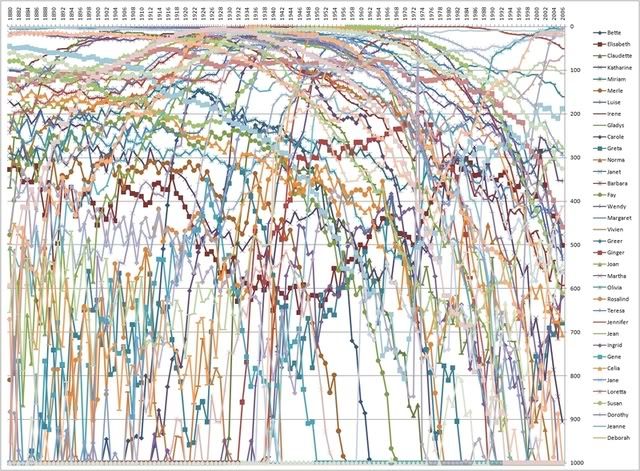
I wanted to see if this trend held true, so I've taken the female Oscar winning and nominated actresses from 1935 to 60, and mapped their names' popularity. The results are below, and yes, you're going to wish I hadn't (I certainly do):


You see, there are lots and lots of Oscar nominated and winning actresses from 1935 to 60. Even when some of the names are repeated (and not all of the names are shown on the left hand side, but I included all the names on this list), such as Judy (Holliday and Garland) and Joan (Fontaine and Crawford), it still adds up to 57 names. So this is a hard graph to analyse because there is a lot going on. I'm not going to go in-depth, and I have a feeling this is one of those graphs that I will see one trend, and someone else will see another.

Ok, so the top left are popular names in 2006 - eg #1 in 2006 (and I know it's better go by % but I would have to look it up for every single year for every single name = long time), bottom right are #1000 and below. Names that went off the top 1000 I put as 1000. So what I am seeing here is a trend of names falling in popularity from the 1970s to 2006, with a few names bucking the trend and rising (Ava, Olivia, Grace, Audrey, Anna) but these are certainly in the minority.

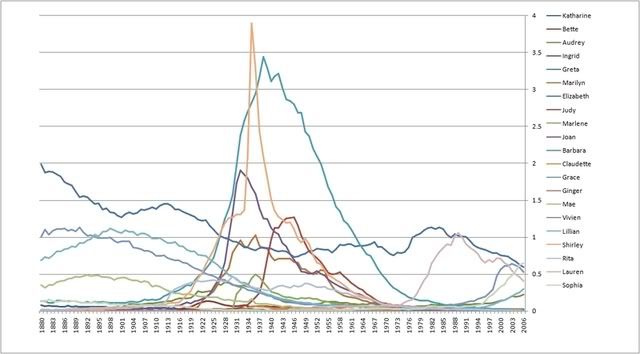
Attempt #2 to look at this trend: the particularly prominent actresses. Using the Oscar winners from 1935 to 60 ignored some recognized 'old Hollywood' actresses such as Marilyn Monroe and Sophia Loren (won 1961). So I'm going to look at the popularity of the names on this list. The list is the American Film Institute's 100 Years...100 Stars, top 25, which was compiled in 1999. The 'stars' on their list had to have died prior to the list being made, or have debuted prior to 1950, and so it is weighted towards 'old Hollywood'. It also usefully allows me not to have to pick and choose as to who is 'old Hollywood'.


A few things to start with - the graph doesn't have the name that for me is the epitome of 'old Hollywood' style: Ava. However, the rest totally fit that category. As the labels aren't particularly clear, the fairly stable, highest at the beginning line is Elizabeth. The two mid-century high peaks are Judy (peach) and Barbara (blue). The light purple one that rises close to the end is Lauren, and the one that has risen and is now declining in blue at the end is Grace. That leaves the risers as Sophia, Lillian and Audrey (as Olivia and Ava are not in the graph). Note that this graph is different from the previous one (and easier to read) as all the percentages have been put in, that took a very long time.

So...what does it tell us?
1) The 'old Hollywood' trend seems to be limited to a few names - Sophia, Lillian, Audrey, Ava, Olivia, with Grace and Lauren as precursors.
2) The majority of 'old Hollywood' names are declining, or have declined so far that they are no longer in the US top 1000 (meaning they could be rising again).
3) The names that are peaking now did not really rise to popularity at the time that their star was famous - whereas Judy and Barbara did, and so now suffer for it as they have a somewhat 'dated' feel.

On a wider scale - there are other names that are quite 'old Hollywood' but are not the names of actresses - one can cite 'Gone with the Wind' as responsible for the sharp increase in the popularity of Melanie and to a lesser extent Vivien and Scarlett in the 1940s - Scarlett has now been revived and Melanie has never been so popular.

Is this post too early? I'd love to look in 5 years and see if Ingrid has made a comeback or Bette - neither were really popular in their 'heyday'. At the moment, we are not having a full scale Hollywood revival, what we are having are names with glimpses of past glamour being found again.

Sunday, January 27, 2008

Simplicity?

This is just going to be a short post. Because of the subject matter, and because I have been feeling very uninspired with this blog recently, I have a couple of topics on the go (analysis of middle names in Scotland, Iceland and Norway, and something 'Mel' names) but they seem very long, and I have no idea if they would interest anyone.

Anyway....

When choosing a name one should strive for true beauty. I understand that that will be different for everyone. And that is what makes names such a fascinating subject that even if I wouldn't choose say Annabel Mary as my favourite, another may, and for them it is stunning.

However, where should the line be drawn?

Does Jane May have more elegance than Elisabetta Rosemary Evangeline Gracia Lovisa, or is the inclusion of someone's five favourite names more important than two? Is the lustre lost by cramming all five together? (and yes, that is quite an extreme example). Should something that flows be more beautiful than something that stumbles but contains every name one likes? And is Evangeline Rose more simple than Alice Clara Jane though they both contain the same number of syllables?

My feeling is nothing can replace the elegance of simplicity. Not even the most gorgeous name created. Names should be succinct or with a succinct nickname, and should complement one another. So Georgina Hannah is out. The repetition isn't complementing, it's a tongue-twister. Three syllables per name should be a maximum except in certain cases (I barely notice 4 in Cordelia, in Evangeline it's glaring). Two three name names is likely to be too much
(think Isabel Marianne vs Isabel Mary). Think less is more, but do have the bare bones - do include a middle name, and do include options. An Elle may not want to be an Elle forever, but as a Gabrielle, she could shine.

Sunday, September 16, 2007

Family Names and Popularity

I have recently made an alphabetical list of all the names in my family tree (both first and middle but not including passed on surnames). Just over 550 names for each gender (1100 overall), stretching from 1500 to the present day. From that I have worked out what are the most popular names, I now want to see which decade they fit best into.

Girls:
There were about 10 more girls names, and more variety in the number of names 190 different names compared with the boys 140. From that I got a top 14 of:


1 Mary
2 Elizabeth
3 Ann
4 Sarah
5 Jane
6 Margaret
7 Florence
8 Catherine
9 Emily
10 Ellen
11 Eliza
12 Frances
13 Alice
14 Annie

Mary and Elizabeth are significantly ahead - Mary with approximately 50 ancestors with the name (either first or middle) and Elizabeth with ten less. The rest decrease from 19 ancestors for Ann and Sarah to 8 for Alice. The top half of this compares very favourably with a top 10 I have for 17001:

1 Mary
2 Elizabeth
3 Ann
4 Sarah
5 Jane
6 Margaret
7 Susan
8 Martha
9 Hannah
10 Catherine

The top 6 are exactly the same, though my family lacks a dearth of Susans, Marthas and Hannahs. Florence became much more popular following Florence Nightingale, at the end of the 19th century, so is unlikely to appear here. Emily can appear interchangeably on records as Amelia.

Boys:
1 John
2 William
3 Charles
4 Thomas
5 James
6 George
7 Alfred
8 Henry
9 Frederick
10 Arthur
11 Edward
12 Harold
13 Peter
14 Francis

This doesn't coorrelate well with any list I have, though there are some similarities to a 1660-9 list2:
1 John
2 William
3 Thomas
4 Robert
5 Richard
6 James
7 George
8 Edward
9 Henry
10 Samuel
11 Joseph
12 Charles
13 Francis

There us no Robert or Richard in my list - mine is rather a mix of 1660s with Victorian revival of Germanic and Arthurian names (Alfred, Arthur, Frederick, Harold). Charles is a strong family name (used father to son on at least two branches of its family), which accounts for its high position. My family has both conformity and quirks.

1 Penguin Dictionary of First Names, Pickering
2 Christian Names in Local and Family History, Redmonds