CLICK HERE FOR BLOGGER TEMPLATES AND MYSPACE LAYOUTS »

Sunday, May 11, 2008

Most Popular Boys' Names in English-speaking World

With the release of the US's top 1000, I thought it was time to bring this back: the most popular names in the English-speaking world released for 2007.

Countries/stats used: England & Wales, Australia (New South Wales, Queensland, Victoria, South Australia, Western Australia), New Zealand, Canada (Alberta, British Columbia, Ontario, Saskatchewan, Nova Scotia), Northern Ireland, Scotland and USA. I couldn't find 2007 stats for the other 'English speaking' areas (eg Republic of Ireland).

This is the first top 20 list, and does not include the mammoth influence of the USA, full stats here:

JACK
JOSHUA
THOMAS
WILLIAM
DANIEL
JAMES
OLIVER
ETHAN
SAMUEL
RYAN
MATTHEW
BENJAMIN
JACOB
HARRY
CHARLIE
ALEXANDER
LIAM
DYLAN
TYLER

Now Jack had over 6500 births in England (most number of births of the countries not including USA), and ended up with approximately 11500 births, 2000 more than the rest. The highest ranking name not in the English list is Lachlan at #61 with 1983 births.

For the 'including US' list, I added all names up to the top 50 and names previously mentioned in other countries' popularity lists, with more than 500 instances. Giving:

JOSHUA
JACOB
ETHAN
DANIEL
WILLIAM
MICHAEL
MATTHEW
ALEXANDER
JAMES
JACK
RYAN
CHRISTOPHER
JOSEPH
NOAH
Anthony
ANDREW
SAMUEL
DAVID
BENJAMIN

1) Jacob is not on top! The US's popular name is not the English speaking world's most popular name. Joshua ranks in 4th in the US, but it's world popularity propels it to the top.

2) Jack is pushed down to #11 by a proportionally small number of American's choosing this name.

3) Other non-US entries to this top 20 are:
Samuel and Benjamin


Just a few other lists: Australia's combined top 20:
JACK
JOSHUA
THOMAS
Lachlan
WILLIAM
ETHAN
Cooper
SAMUEL
RYAN
JAMES
RILEY
NOAH
OLIVER
DANIEL
LUCAS
BENJAMIN
LIAM
ALEXANDER
JACOB


Canada's combined top 20 (not including Quebec, or other areas that did not provide 07 data):

ETHAN
MATTHEW
JACOB
JOSHUA
RYAN
ALEXANDER
BENJAMIN
OWEN
DANIEL
NOAH
LIAM
NATHAN
WILLIAM
Nicholas
LUCAS
LOGAN
SAMUEL
JACK
MICHAEL


And the UK (combing England & Wales, Scotland and N Ireland):
JACK
THOMAS
OLIVER
JOSHUA
DANIEL
HARRY
JAMES
CHARLIE
WILLIAM
ALFIE
LEWIS
SAMUEL
JOSEPH
GEORGE
ETHAN
BENJAMIN
DYLAN
MATTHEW
RYAN

More statistical versions of these lists can be found here

Monday, April 07, 2008

Quick update

This is just a quick update as to what I am looking into at the moment:
-Old Hollywood style (this post may even be finished soon) - FINISHED! See below
-Florence and names spawned from the Crimea
-Middle names, looking in particular at Scotland, Iceland and Norway
-'Mel' names
-Names to avoid (though at the moment this is feeling very generic)

If you have a burning desire to see any of these posts soon or know more about them then please comment and I will see what I can do

Saturday, April 05, 2008

Old Hollywood Style

So this is a trend people are noticing, particularly in female names - that a lot of popular and rising female names, especially in the US, are names borne by Hollywood actresses of the 1940s and 50s. The most obvious is Ava - Ava Gardner, though one can accredit the popularity of Audrey to Audrey Hepburn, Grace to Grace Kelly, Olivia to Olivia de Havilland and Sophia to Sophia Loren.

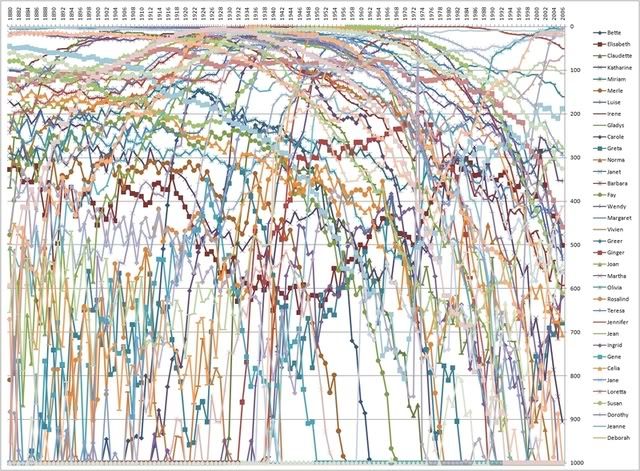
I wanted to see if this trend held true, so I've taken the female Oscar winning and nominated actresses from 1935 to 60, and mapped their names' popularity. The results are below, and yes, you're going to wish I hadn't (I certainly do):


You see, there are lots and lots of Oscar nominated and winning actresses from 1935 to 60. Even when some of the names are repeated (and not all of the names are shown on the left hand side, but I included all the names on this list), such as Judy (Holliday and Garland) and Joan (Fontaine and Crawford), it still adds up to 57 names. So this is a hard graph to analyse because there is a lot going on. I'm not going to go in-depth, and I have a feeling this is one of those graphs that I will see one trend, and someone else will see another.

Ok, so the top left are popular names in 2006 - eg #1 in 2006 (and I know it's better go by % but I would have to look it up for every single year for every single name = long time), bottom right are #1000 and below. Names that went off the top 1000 I put as 1000. So what I am seeing here is a trend of names falling in popularity from the 1970s to 2006, with a few names bucking the trend and rising (Ava, Olivia, Grace, Audrey, Anna) but these are certainly in the minority.

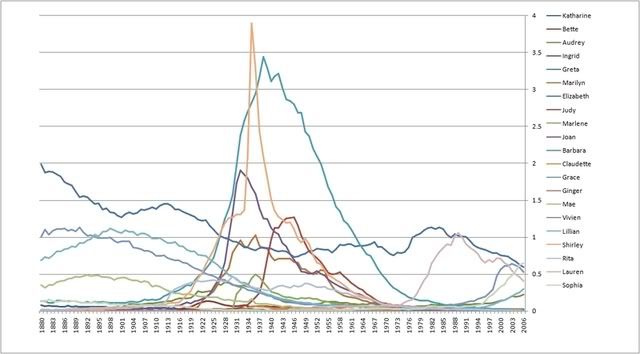
Attempt #2 to look at this trend: the particularly prominent actresses. Using the Oscar winners from 1935 to 60 ignored some recognized 'old Hollywood' actresses such as Marilyn Monroe and Sophia Loren (won 1961). So I'm going to look at the popularity of the names on this list. The list is the American Film Institute's 100 Years...100 Stars, top 25, which was compiled in 1999. The 'stars' on their list had to have died prior to the list being made, or have debuted prior to 1950, and so it is weighted towards 'old Hollywood'. It also usefully allows me not to have to pick and choose as to who is 'old Hollywood'.


A few things to start with - the graph doesn't have the name that for me is the epitome of 'old Hollywood' style: Ava. However, the rest totally fit that category. As the labels aren't particularly clear, the fairly stable, highest at the beginning line is Elizabeth. The two mid-century high peaks are Judy (peach) and Barbara (blue). The light purple one that rises close to the end is Lauren, and the one that has risen and is now declining in blue at the end is Grace. That leaves the risers as Sophia, Lillian and Audrey (as Olivia and Ava are not in the graph). Note that this graph is different from the previous one (and easier to read) as all the percentages have been put in, that took a very long time.

So...what does it tell us?
1) The 'old Hollywood' trend seems to be limited to a few names - Sophia, Lillian, Audrey, Ava, Olivia, with Grace and Lauren as precursors.
2) The majority of 'old Hollywood' names are declining, or have declined so far that they are no longer in the US top 1000 (meaning they could be rising again).
3) The names that are peaking now did not really rise to popularity at the time that their star was famous - whereas Judy and Barbara did, and so now suffer for it as they have a somewhat 'dated' feel.

On a wider scale - there are other names that are quite 'old Hollywood' but are not the names of actresses - one can cite 'Gone with the Wind' as responsible for the sharp increase in the popularity of Melanie and to a lesser extent Vivien and Scarlett in the 1940s - Scarlett has now been revived and Melanie has never been so popular.

Is this post too early? I'd love to look in 5 years and see if Ingrid has made a comeback or Bette - neither were really popular in their 'heyday'. At the moment, we are not having a full scale Hollywood revival, what we are having are names with glimpses of past glamour being found again.

Sunday, January 27, 2008

Simplicity?

This is just going to be a short post. Because of the subject matter, and because I have been feeling very uninspired with this blog recently, I have a couple of topics on the go (analysis of middle names in Scotland, Iceland and Norway, and something 'Mel' names) but they seem very long, and I have no idea if they would interest anyone.

Anyway....

When choosing a name one should strive for true beauty. I understand that that will be different for everyone. And that is what makes names such a fascinating subject that even if I wouldn't choose say Annabel Mary as my favourite, another may, and for them it is stunning.

However, where should the line be drawn?

Does Jane May have more elegance than Elisabetta Rosemary Evangeline Gracia Lovisa, or is the inclusion of someone's five favourite names more important than two? Is the lustre lost by cramming all five together? (and yes, that is quite an extreme example). Should something that flows be more beautiful than something that stumbles but contains every name one likes? And is Evangeline Rose more simple than Alice Clara Jane though they both contain the same number of syllables?

My feeling is nothing can replace the elegance of simplicity. Not even the most gorgeous name created. Names should be succinct or with a succinct nickname, and should complement one another. So Georgina Hannah is out. The repetition isn't complementing, it's a tongue-twister. Three syllables per name should be a maximum except in certain cases (I barely notice 4 in Cordelia, in Evangeline it's glaring). Two three name names is likely to be too much
(think Isabel Marianne vs Isabel Mary). Think less is more, but do have the bare bones - do include a middle name, and do include options. An Elle may not want to be an Elle forever, but as a Gabrielle, she could shine.

Sunday, September 16, 2007

Family Names and Popularity

I have recently made an alphabetical list of all the names in my family tree (both first and middle but not including passed on surnames). Just over 550 names for each gender (1100 overall), stretching from 1500 to the present day. From that I have worked out what are the most popular names, I now want to see which decade they fit best into.

Girls:
There were about 10 more girls names, and more variety in the number of names 190 different names compared with the boys 140. From that I got a top 14 of:


1 Mary
2 Elizabeth
3 Ann
4 Sarah
5 Jane
6 Margaret
7 Florence
8 Catherine
9 Emily
10 Ellen
11 Eliza
12 Frances
13 Alice
14 Annie

Mary and Elizabeth are significantly ahead - Mary with approximately 50 ancestors with the name (either first or middle) and Elizabeth with ten less. The rest decrease from 19 ancestors for Ann and Sarah to 8 for Alice. The top half of this compares very favourably with a top 10 I have for 17001:

1 Mary
2 Elizabeth
3 Ann
4 Sarah
5 Jane
6 Margaret
7 Susan
8 Martha
9 Hannah
10 Catherine

The top 6 are exactly the same, though my family lacks a dearth of Susans, Marthas and Hannahs. Florence became much more popular following Florence Nightingale, at the end of the 19th century, so is unlikely to appear here. Emily can appear interchangeably on records as Amelia.

Boys:
1 John
2 William
3 Charles
4 Thomas
5 James
6 George
7 Alfred
8 Henry
9 Frederick
10 Arthur
11 Edward
12 Harold
13 Peter
14 Francis

This doesn't coorrelate well with any list I have, though there are some similarities to a 1660-9 list2:
1 John
2 William
3 Thomas
4 Robert
5 Richard
6 James
7 George
8 Edward
9 Henry
10 Samuel
11 Joseph
12 Charles
13 Francis

There us no Robert or Richard in my list - mine is rather a mix of 1660s with Victorian revival of Germanic and Arthurian names (Alfred, Arthur, Frederick, Harold). Charles is a strong family name (used father to son on at least two branches of its family), which accounts for its high position. My family has both conformity and quirks.

1 Penguin Dictionary of First Names, Pickering
2 Christian Names in Local and Family History, Redmonds

Monday, August 20, 2007

Names and Fiction

Or more specifically names in a certain series of fiction - the Chalet School. Basically, looking at how realistic the names are in contrast with the time they were written.There are a few problems with the method I am using, that I am going to outline.

1) The early Chalet School books (School at the Chalet through to Exile) take place in Austria, where a lot of local girls attend. The school is much more international during this time, drawing pupils from throughout Europe. This is reflected in the names, and thus skews the data. I am therefore focussing primarily on the names in the later books.

2) The information that I am going to use to compare them with is the US statistics (top 1000) as these are much more accessible than the British data for the period. This is not ideal, but this entry is not expected to be a thesis, just an overview.

3) Elinor Brent-Dyer (EBD) isn't exactly consist in all of her dates (some people age too quickly, others too slowly etc.), I am using the dates on the site I link to in the next paragraph.

Much of the information I am using is, of course, from Elinor M Brent-Dyer's books. They have been usefully collated here.


The late 1920s girls:
In the US, the late 1920s saw the dominance of Mary - almost twice as many Marys were born in 1928 than the #2 name - Betty. It accounted for 5.5% of all names here. With the Chalet School, the popularity is more pronounced - 4 out of the 48 names are Mary - 10%, additionally with the nickname Mollie and alternative form Marie appearing as well.

Margaret was another name peaking in the 1920s, though only accounted for 1.6% of births. With the CS, we have Margaret as well as Meg and Peggy. Additionally, the Daisy of the list, is actually a Margaret. This leaning upon Margaret is well documented throughout the series - the founder of the Chalet School is a Margaret, her mother-in-law is a Margaret, so her sister-in-law has a Margaret (the aforementioned Daisy). Original Margaret (or Madge, as she is more commonly known), is honoured by her twin brother with his first daughter (known as Peggy), and her sister with one of her triplet daughters (known as Margot). Additionally, Madge's ward Juliet, has a Meg.

None of the other members of the US top 5 for this period (Helen, Dorothy and Betty) appear, though there is a Beth, a Lysbet, an Isabel and various attempts to avoid Dorothy (Dorcas, Doreen, Doris, Dorothea). Of the other members of the top 10 - Ruth, Doris, Barbara, Virginia and Shirley, only Doris and Barbara appear.

What else is there? There are three Annes (one Anne, two Nancys), which in the US was experiencing a drop in popularity. Two Franceses (#13 in the period), Roosje sticks out as a reminder of the previous international nature of the school, and Edris (an attempt at Idris?) and Gwensi appear as precursers of what is to come (moving of the school to Wales).

1930-5 girls:
I'll be focussing on 1933 US data for this part. This section of girls is considerably larger - we only started with about 1928 last time. Mary is slightly less popular by this time - down to 5.3% of population, and this is reflected in the CS. Out of 158 girls we have 3 Marys, 2 Mollies, 1 Polly and a Marie - approx. 4.5% - closer to the US than last time. The name that is rising in popularity in the US, Barbara, appears 3 times, though that is roughly the same %ge as last time. This may be marred by the fact that one of the more principal characters in this section of the series is a Barbara. Betty still doesn't appear - we have Bess, Betsy and Elizabeth - but Dorothy (#4) does once on a minor character, Joan (#5) appears twice and Patricia (#6) does in the form of Pat.

Margaret, once again, is very strong. There are 3 Madges (1 from Magdalen), 3 Margarets, 1 Meg and 2 Peggys, only one of home (a Peggy) being easy to link with the school foundress.

There is also a surplus of Anne's which goes against the US's fall - 7 Annes, 1 Anne-Marie, 1 Annis, 1 Nan and 1 Nancy.

Of the 'unusual' names, we have a couple of double occurrences of names that I would consider rare in English - Diana, Joy, La/eila, Lilias, Nina and Nita, Primrose and Primula and Rosalind.

A little thing to point out - the main characters born during this time: Mollie McNab, Peggy Bettany, Nita Eltringham, Bride Bettany, Nancy Chester, Tom (Lucinda Muriel) Gay, Julie Lucy, Flora and Fiona MacDonald, Vanna and Nella Ozanne, Primula Venables, Clem(ency) Barras, Carola Johnstone, Betsy Lucy, Sybil Russell and Blossom Willoughby (some more principal due to family rather than anything they do). Of these 17, 14 have 'individual' names (not worn by another character of this age range, though some eg Nita and Betsy are similar to others).

1935-40 girls:
This age group is roughly the same size as the previous. The top 10 in the US in 1938 was Mary, Barbara, Patricia, Betty, Shirley, Carol, Nancy, Dorothy, Margaret and Joan. A quick skim through this set of CS data shows that Mary and Marie are plentiful, as are Hilda and Iris.

Mary has retained it's strong popularity - we have 3 Marys, 1 Mary-Lou and 1 Mollie, but does appear to be overshadowed by the 3 Maries and 1 Marie-Therese. What this data hides is that fact that the Len, Con and Margot all have Mary as their first names but, as triplets, go by their middle names. A principal character during this stage of the story is Mary-Lou which may explain why Marie has increased as an alternative to Mary. Additionally, with the move of the school to Switzerland, there is an increase in 'international' pupils - Marie being the French form of the name.

Anne is the name that has taken a huge knock during this time: only 2 Annes, but an Anna and an Anneli (both are Swiss) and a Nan (no Nancys so flying in the face of the American popularity). Anne itself was still decreasing during this time.

Margaret also does not appear prominent - there is only one, who appears not to have any link with the school foundress. Margot does (school foundress's niece), and this time there are no Megs but one Peggy (not related). This decrease in Margarets coincides with the school foundress's removal from school life - first to Canada and then Australia. This also neatly coincides with the ascendancy of the name Hilda - only one has been in the data before, but this time there are three. This amount also flies in the face of the American data where Hilda is decreasing. The headmistress at this time is Hilda Annersley, which must have at least kept the name at the forefront of EBD's mind when naming characters.

In terms of unusual names, there is quite a plethora: Amandine, Carmela, Catriona, Chloe, Emerence, Ghislaine, Lesceline, Nesta, Olwyn, Penelope, Richenda, Truda, Ursula, Yseult and Zena spring out.

As for the 'no characters named similarly to main characters' - in this section the main characters are Mary-Lou, Len, Con, Margot, Verity-Anne, Barbara, Vi, Josette, Jo, Ted, Rosamund and Yseult. Of these 12, only Barbara and Rosamund are repeat names, though Josette and Jo are similar in the bank of 'Jo-' names of the time: 2 Joans, Jocelyn and Josefa in addition.

1940+ girls:
This group is larger than the others. We never see these girls 'lead' the school, so that is why I have grouped them together. There is a very international feel here - out of the c.230 names here, I would guess (without checking surnames or nationalities) that 80-100 are not traditional English choices, and are much more international.

Anne has retained its popularity - there are 6 here compared with just one Anna. Annelise, Annette also appear, but just one Anna this time. Mary is still diminishing (just 3) - especially in the face of the 7 Maries and 2 Marias. Jeanne is also performing well with 4 appearances. As a general point of interest, the most popular names in France in the early in1940s were Monique, Nicole, Danielle, Michele and Jacqueline, of which only Michele appears in the Michelle form. EBD's names are much more of the 1910s and 1920s when Jeanne, Marie, Madeleine, Simone, Yvonne, Odette and Denise were all popular.

To view the data I used go here

Thursday, July 19, 2007

Comparing the English-speaking world on names (girls)

Whilst Wikipedia lists that there are 75 countries where English is the official language, I am just going to focus on the few that I can get popularity data for, and the larger countries (apologies to Christmas Island and Tristan da Cunha). The general decision is US, England and Wales, Canada, Australia, Republic of Ireland, New Zealand, Scotland, Northern Ireland, Wales (separate from England) and Malta, due to information available.

Popularity data used:
US: SSA
England and Wales: National Statistics
Canada: Today's Parent- government does not appear to publish one complete list
Australia: Baby Name Stats - again, only regional - this site shows all regions on one page
Republic of Ireland: Central Statistics Office
New Zealand: Department of Internal Affairs
Scotland: General Register Office
Northern Ireland: Statistics and Research Agency (pdf)
Wales: National Statistics (pdf)
Malta: National Statistics Office (pdf)

So...let's start with the USA, and starting simply with the top 10:
Name Frequency % Compared with previous yr
Position Generally
Emily 21118 1.0267 - falling
Emma 18838 0.9159 - falling
Madison 18395 0.8944 - falling
Isabella 17954 0.8729 +2 rising
Ava 16741 0.8139 +4 rising rapidly
Abigail 15429 0.7502 -2 falling slowly
Olivia 15244 0.7412 -2 falling
Hannah 14294 0.6950 -1 falling
Sophia 13313 0.6473 +2 rising quickly
Samantha 12316 0.5988 -2 falling

The 'Generally' results are based upon Name Voyager, the next information is from BNW
Language of origin Additional Information
Emily Latin 3 saints named Emily
Emma German 'Emma' by Jane Austen
Madison English Surname of American President, place name
Isabella Hebrew via Italian Frequent name used in royalty
Ava German Ava Gardner
Abigail Hebrew Biblical
Olivia English or Latin Shakespearean
Hannah Hebrew Biblical
Sophia Greek city of Sofia
Samantha Aramaic via English Samantha from Bewitched (TV)

There is a mix here of Biblical (Abigail, Hannah, and possibly Samantha (from Samuel)), cultural (Ava, Isabella, Emma, Olivia, Madison and Samantha) and others - it's difficult for some (Emily, Emma, Sophia, Isabella) to pin down exactly why they are popular. Hebrew and English are the most common origins.

England and Wales

England doesn't provide much past rank - no % or #s of births. However, we do know that in 2006 there were almost 670 000 live births in England and Wales, and that there were 6928 Jacks born in 2006. Assuming that half of all births are male = 335 000 boys born in 2006. 6928 is 2.06% of 335 000, so just over 2% of boys born in 2006 were named Jack. As the American data shows, % for male and female are similar, though female % are slightly less. The British male popularity % goes: 1. 2 .06%, 2. 1.78%, 3. 1.76%, 4. 1.73%, 5. 1.55%, 6. 1.5%, 7. 1.42%, 8. 1.29%, 9. 1.29%, 10. 1.28% - this suggests that 15.7% of boys born in England & Wales in 2006 had a name in the top 10. I would guess that's about 13.5% for girls - divided up this way:

% Rough no. # on last year
Olivia 1.8 6030 +3
Grace 1.75 5863 +5
Jessica 1.75 5862 -2
Ruby 1.5 5025 +11
Emily 1.45 4858 -4
Sophie 1.4 4690 -3
Chloe 1.4 4690 -2
Lucy 1.35 4523 -
Lily 1.35 4522 +7
Ellie 1.3 4355

Olivia and Jessica have swapped the top spot in the last year, so I would guess that there wouldn't be much between Olivia, Jessica and Grace. Ruby jumped in the last year from #15 to #4 so I would guess it is slightly less popular than Ruby. There may be slightly more than half a percent between Chloe (a former #1 name) and Lucy which has stuck at the end of the top 10 since at least 2002.

The England and Wales list shows much more mobility than the US list - there are 3.5 more births in the US than for GB, but the largest change in the US is +4, compared eclipsed by England and Wales's +5, +11, +7 and -4. The changes in 5 years are similar - Ashley, Alexis and Sarah are on the US top 10 in 2002, as is Megan, Charlotte and Hannah - 3 names changed. They have also both had a name 'pop in' in the intervening time - Katie for England, and Elizabeth for USA.

Language of origin Additional information
Olivia English or Latin Shakespearean
Grace Latin Virtue
Jessica Shakespeare (Hebrew?) Shakespearean
Ruby Latin via English Colour, gemstone
Emily Latin 3 saints named Emily
Sophie Greek via French City of Sofia?
Chloe Greek Mythological
Lucy Latin via French and English Saint, Narnia, nickname
Lily English Flower, nickname
Ellie Depends Nickname

One thing that is completely different between the US and England and Wales popularities are the endings of the names. The US is dominated by 'a' - Emma, Isabella, Ava, Olivia, Hannah, Sophia and Samantha. In England and Wales, the sound is 'ee' - Ruby, Emily, Sophie, Chloe, Lucy, Lily and Ellie. 'ee' sounds are much more nicknameish - in the US, Mia is the only possible nickname in the top 20, in the UK there is Lucy, Lily, Ellie, Ella, Katie, Mia, Megan and Millie. Whilst some (Lucy, Lily, Ella, Mia and Megan) can stand quite well alone, there is a certain level of informality in England and Wales, which is not found in the US. The last time a name that I would say cannot stand on its own - has to be a nickname, was found in the US top 50 was way back in 1940 with Betty (I think Sandra, Lisa, Donna, Linda, Amy can stand alone). In the UK this was 2004 with Ellie.

None of the British names are Biblical - Grace is a virtue, but none have a strongly Christian basis like the US names. Whilst 71.6% of British people count themselves as Christian, it has been surveyed that only half that believe there is a god (any god), and this is also on the decline. 76.7% of Americans have cited themselves as Christians and only 14% as atheist/agnostic - this is reflected with Abigail and Hannah. In the UK the first Biblical name (apart from Grace) is Hannah at #15.

Canada:
The information I am using (from Today's Parent) has the advantage of grouping similar spellings together. One of the big disadvantages of the US and England and Wales's policy of going by spelling instead of sound is that some popular names are disguised. This is most obvious in the US with the popularity of Aidan - its #1 sounded name, despite Aiden, it's most popular form, only being #30. For ease of use, I haven't acknowledged sounded names yet, but for the US the top 10 is: Emily, Madison, Isabella, Emma, Sophia, Hailey, Kaitlyn, Abigail, Ava, Olivia. (or Emily, Mia, Madison if you think Mia and Maya are pronounced the same).

Anyway, Canada. They only release positions, and I can't find anything like the Times article which I used to compile the girls rough #s. Today's Parent say they have compiled their list from: 'provincial resources where available 2004/2005', I'm slightly wary but I do want to see if there are some comparisons between a more recent British colony (achieved dominion status 1867, independence 1931) and a North American country.

Language of Origin Additional info
Emma German 'Emma' by Jane Austen
Emily/Emilie Latin 3 saints named Emily
Sarah/Sara Hebrew Biblical
Madison/Madisyn English Surname of American President
Hannah/Hanna Hebrew Biblical
Olivia English or Latin Shakespearean
Hailey/Hayley English Surname
Maya/Mia Hebrew or Italian Nickname, noun name
Kaitlyn/Katelyn Gaelic Somewhat smooshy
Abigail/Abigayle Hebrew Biblical

Interesting to see an American president's surname on the list. The popularity of the name as a name rather than honouring (though to be honest, Madison didn't peak until after 'Splash!' film). Approx. 4.4% of Canadian immigrants in 2001 were from the US. So if they all named their child Madison... Approx. 230 000 immigrants were accepted into Canada in 2004, that's around 10 000 Americans, going by half women that would be 5000 women. If that was the same for the next few years and these 20 000 women all had children at the same time...no, I don't think it's conceivable. Madison is certainly travelling due to sound rather than any ideas of honouring.

This Canadian list is very similar to the US combined spellings list - some of the positions are different, Isabella, Sophia and Ava are not on the Canadian list but the new entries through combined spellings - Hailey, Maya and Kaitlyn are. Isabella and Sophia are in particular Spanish, Italian choices - a product of Mexican and similar immigration to the US, that does not happen to Canada?

There is one more Biblical choice (Sarah) in the Canadian list, 72% of Canadians class themselves as Roman Catholic or Protestant. Canada certainly doesn't share it's Commonwealth cousin Britain's affinity for nicknames - past Mia, there is only one other nickname (Megan) in the top 20, and the first 'too informal to stand alone' nickname is Abby at #72 (ignoring Ella).

Australia:
Australia doesn't border America, so in theory, it should have less concurrence with the American choices than Canada. It is a former colony of Britain (achieved federation in 1901, legislative independence adoption in 1942), so there may be some similarity there.

Some guesswork has to go into compiling the complete Australian popularity chart. The site I use gives births for all the territories except Australian Capital Territory and Northern Territory. This is the compiled list for the rest of Australia:
# of births

Ella 1590
Chloe 1519
Emily 1502
Olivia 1416
Charlotte 1384
Jessica 1226
Isabella 1220
Sophie 1191
Mia 1165
Sienna 837

260 000 babies were born in Australia in 2005 - this was an increase of 5000. Assuming this increased by another 5000 in 2006 that would make 265000 babies and 132 500 girls.
ACT has a population of 333667, Australia's population is approx. 21 000 000. ACT contains 1.59% (1.6%) of Australia's population, so we assume that they had 1.6% of its female births - 2120. Let's say 15% of this 2120 is in the top 10 - so 1.9+1.8+1.7+1.7+1.5+1.5+1.4+1.3+1.2+1 = 15%.
% Rough # of births
Charlotte 1.9 40
Ella 1.8 38
Emily 1.7 36
Sophie 1.7 36
Jessica 1.5 32
Isabella 1.5 32
Chloe 1.4 30
Grace 1.3 28
Hannah 1.2 25
Olivia 1 21

We can do the same with the data for the Northern Territory.
It has a population of 205, 000 - approx. 1% of Australia's population - 1% of female births = 1325. Using the same 15%:
% Rough # of births
Emily 1.9 25
Ella 1.8 24
Georgia 1.7 23
Grace 1.7 23
Chloe 1.5 20
Isabella 1.5 20
Jessica 1.4 19
Lily 1.3 17
Mia 1.2 16
Sarah 1 13

The first popularity list only incorporates the top 10, with this new data for ACT and Northern Territory, plus incorporating the popularity of the names when they didn't feature within the top 10, the rough top 10 for Australia is:


# of births Language of Origin Additional Info
Ella 1652 Depends Nickname
Chloe 1569 Greek Mythological
Emily 1563 German Name of 3 saints
Charlotte 1546 German First Fleet ship
Olivia 1437 English or Latin Shakespearean
Jessica 1277 Shakespeare (Hebrew?) Shakespearean
Isabella 1272 Hebrew via Latin Frequent name used in royalty
Mia 1258 Hebrew or Italian Nickname, noun name
Sophie 1227 Greek via French City of Sofia?
Sienna 1087 Italian City, colour

Some usual sights here - Olivia, Emily, Isabella. The Australians seem, like the British, to favour Sophie over Sophia. Charlotte is also very popular - it was one of the First Fleet ships, but I'm not sure whether that is a good enough reason for its popularity, as Alexander - another First Fleet ship, doesn't seem to be unusually popular. Sienna has caught on in Australia as well - it's only #70 in Britain, #177 in US and #98 in Canada. Australia's Ruby perhaps? Though it has a different American popularity ark to Ruby.

New Zealand:
I'm going onto NZ next, as it seems to fit better with Australia than Ireland does.
NZ don't provide numbers, just names:


Language of Origin Additional Info
Charlotte German First Fleet ship
Ella Depends Nickname
Sophie Greek via French City of Sofia?
Emma German 'Emma' by Jane Austen
Olivia English or Latin Shakespearean
Emily German Name of 3 saints
Grace Latin Virtue
Jessica Shakespeare (Hebrew?) Shakespearean
Hannah Hebrew Biblical
Lily English Flower, nickname

The NZ chart is very similar to Australia and England and Wales(it shares 6 of the same names). Sophie is once again preferred over Sophia. Fewer Biblical names. I don't know how much influence the Charlotte/First Fleet would have. This list adds nothing new.

Ireland:
We move now back to Europe and to Ireland, former British colony (until 1921), official languages of Irish and English, which should have an effect. The Irish statistics give both position and # of births.


# of births Language of origin Additional info
Emma 703 German 'Emma' by Jane Austen
Sarah 642 Hebrew Biblical
Katie 575 Greek Nickname
Amy 510 French Literature (Little Women)
Aoife 492 Gaelic Mythological
Ciara 384 Gaelic Singer? Traditional Irish
Sophie 451 Greek via French City of Sofia?
Chloe 440 Greek Mythological
Leah 427 Hebrew Biblical
Ella 405 Depends Nickname

Even without the Irish choices, this is still a little different - we have Leah here, and Katie. Sophie is favourite once again over Sophia. We have a fairly even mix between 'ah' and 'ee' (6:4). Aoife and Ciara are particularly interesting as the Irish choices, with the mix of 'Western choices'. Ireland has one of the highest rates of weekly church attendance in the western world - this is reflected by Sarah, Ciara, Leah and Chloe.

Northern Ireland:
Northern and the Republic of Ireland were joined until 1921, and NI stayed a part of the UK. N Ireland do not produce statistics with number of babies born each year.


Language of origin Additional info
Katie Greek Nickname
Grace Latin Virtue
Emma German 'Emma' by Jane Austen
Sophie Greek via French City of Sofia?
Ellie Depends Nickname
Lucy Latin via French and English Saint, Narnia, nickname
Sarah Hebrew Biblical
Hannah Hebrew Biblical
Jessica Shakespeare (Hebrew?) Shakespearean
Erin Gaelic via English Poetic name for Ireland

This is very reminiscent of the England and Wales top 10 (5 names shared), Ireland (4 names shared) and NZ (4 names). Erin is new, but there are less Irish names in this top 10. Few Biblical, virtues - same sort of feel as everywhere else.

Scotland:
The Scots provide a whole variety of popularity information -from the simple top 20, to a spreadsheet of all the names given in a year (so you can see that one little girl was lucky enough to be named Abiygayil and another Magic) with numbers of usage.


# of births Language of origin Additional info
Sophie 602 Greek via French City of Sofia?
Emma 452 German 'Emma' by Jane Austen
Erin 443 Gaelic via English Poetic name for Ireland
Katie 441 Greek Nickname
Lucy 431 Latin via French and English Saint, Narnia, nickname
Chloe 425 Greek Mythological
Ellie 421 Depends Nickname
Amy 396 French Literature (Little Women)
Olivia 337 English or Latin Shakespearean
Emily 336 German Name of 3 saints

This is similar to N Ireland (6 the same) but lacks any markedly 'Scottish' names, and interestingly has Erin on the list. Scotland shares England and Wales' love of 'ee' names (Sophie, Katie, Lucy, Chloe, Ellie, Amy and Emily) and of nicknames. There is a lack of Biblical or even virtue names in the list - 27.5% of Scots consider themselves to have no religion, around 60% consider themselves Christians.

Wales
National Statistics provide additional information for the top names in Wales (but not England). Wales has a whole variety of names, so there should be some impact there, like with Ireland. Wales do not provide numbers of births.


Language of origin Additional info
Megan Greek, Welsh Nickname
Jessica Shakespeare (Hebrew?) Shakespearean
Olivia English or Latin Shakespearean
Ellie Depends Nickname
Emily German Name of 3 saints
Ruby Latin via English Colour, gemstone
Chloe Greek Mythological
Sophie Greek via French City of Sofia?
Grace Latin Virtue
Ffion Welsh Flowers, Ffion Hague?

Two Welsh choices on the list - Megan and Ffion (I don't think Ffion is encountered anywhere else). Ruby is back, as are the ee endings but with less intensity than Scotland.

Malta
Malta is the smallest of the places on our list, with only 3885 live births in 2006. 4% of all girls names was Maria and its variants - to get that kind of exposure in the US you have to go back to 1974 and the pinnacle of Jennifer's popularity. Malta was a part of the British empire until 1964, and its official languages are Maltese (similar to Arabic) and English.


# of births Language of origin Additional info
Maria/Mariah 73 perhaps Hebrew Biblical
Maya 53 Greek Mythological
Amy 43 French Literature (Little Women)
Martina 40 Latin Empress, tennis players
Emma 40 German 'Emma' by Jane Austen
Shania 36 Yiddish Shania Twain
Ylenia 35 Italian? Ylenia Carrisi
Michela/Michaela 35 Hebrew via Latin Michael is saints name
Sarah 35 Hebrew Biblical
Elisa/Eliza 33 Hebrew Biblical
Julia 32 Latin Roman
Jasmin 30 Indian/Persian Flower, disney?
Hailey 27 English Surname

The first thing noticed is that there are more than 10 names - with so few births, it has come that some names are used several times. There is a definite 'pop culture' influence here - especially with Shania, possibly Mariah, Ylenia, Jasmin and Hailey. Malta is Mediterranean and there is a definite Italian/Spanish influence with the amount of 'ah' names - only Amy, Jasmin and Hailey don't end with this sound. Additionally, Biblical comes out quite well.

Most Popular
This brings me to the subject of: which name is...probably...the most popular in the English speaking world. I did some calculations (similar to those I set out before) and this is what I found - not conclusive but possible. A rough top twenty, with rough figures of # of births in 2006:


# of births USA England/UK Canada Australia NZ Ireland
Emily 32962 Emily Olivia Emma Ella Charlotte Emma
Emma 27025 Emma Grace Emily Chloe Ella Sarah
Isabella 24974 Madison Jessica Sarah Emily Sophie Katie
Olivia 24686 Isabella Ruby Madison Charlotte Emma Amy
Madison 24604 Ava Emily Hannah Olivia Olivia Aoife
Hannah 23429 Abigail Sophie Olivia Jessica Emily Ciara
Ava 21714 Olivia Chloe Hailey Isabella Grace Sophie
Grace 21617 Hannah Lucy Maya/Mia Mia Jessica Chloe
Abigail 20668 Sophia Lily Kaitlyn Sophie Hannah Leah
Chloe 20286 Samantha Ellie Abigail Sienna Lily Ella
Mia 19853 Elizabeth Ella Grace
Isabella Emily
Sarah 17999 Ashley Charlotte Jessica
Lucy Rachel
Jessica 17782 Mia Katie Megan
Chloe Niamh
Ella 17435 Alexis Mia Julia
Ruby Grace
Sophia 17282 Sarah Hannah Sophia
Georgia Rebecca
Elizabeth 15527 Natalie Amelia Lauren
Paige Hannah
Samantha 14906 Grace Megan Isabella
Amelia Caoimhe
Lily 13706 Chloe Amy Samantha Maia Ava
Ashley 13482 Alyssa Isabella Chloe
Zoe Lauren
Sophie 12381 Brianna Millie Rachel
Madison Jessica

The biggest US movements I can see are Sophie (#125 in US to #20), Lily (#33 to 18) Ella (#21 to 14) and Grace (#17 to 8). I'm focussing on US as that is the place with the most births and thus the place where it was most difficult to shift each name's position - Emily stays #1 though it isn't #1 anywhere else, Charlotte doesn't make it into top 20 despite featuring highly in NZ and Australia (it ended up #24). Grace is one name that does change - through its strong popularity in England. Sophie is another - it's US 2730 births were boasted by almost 10000 through its popularity in England, Australia, NZ and Scotland.

As for 'ee' vs 'ah' - 11 'ah's to 5 'ee's: the US popularity plays a very strong hand here.

I hope this has been fairly informative, apologies for the squishy formatting earlier on. I doubt I'll do such a detailed boys examination - possibly just make up a list.


Tuesday, July 10, 2007

Some Unusual Mythological Names

Taking a break from the usual programme because...it's very time-consuming. Anyway here is a bunch of completely unusable mythological names with fairly nice connections (then again see Cloacina).

Aegina - one of Saronic islands, from Aegina who was the mother of Aeacus by Zeus
Amalthea - she-goat who nursed infant Zeus
Aphaia - goddess worshipped in Aegina
Callirhoë - lots of characters here - an oceanid, a naiad, daughter of river-god Achelous and river-god Scamander,
Chione - snow-nymph
Cleodora - one of the Danaids, fifty daughters of Danaus who were forced to marry fifty sons of Aegyptus. On their wedding night, 49 of the daughters murdered (on Danaus' orders) their husbands.
Cloacina - Roman goddess presiding over the sewers in Rome
Creusa - several characters - naiad, second wife of Jason (also identified as Glauce), daughter of Priam of Troy, daughter of Erechtheus of Athens
Egeria -Roman goddess connected with Diana, and associated with water. Wife of second king of Rome.
Eileithyia - goddess of childbirth and midwifery
Idaea - nymph, wife of Scamander
Ilia - another name for Rhea Silvia
Issa -daughter of Macareus, beloved by Apollo
Juturna - Roman goddess of fountains, wells and springs
Leucothea - sea deity, the 'white goddess'
Marpessa - daughter of river god Evenus/o
Pasiphaë - daughter of Helios (the Sun) and mother of the Minotaur
Pherusa - nereid
Pomona - Roman goddess of fruit trees, gardens and orchards
Semiramis - Assyrian queen, mythical founder of Nineveh

If you want more information on them then Google or Wikipedia are your friends.

Saturday, June 16, 2007

Adelaide, Aeronwy, Graciana, Lucasia and Meiriona

Adelaide
add-eh-lade

Popularity:
There are 19 women in Norway named Adelaide
There was 1 baby in Scotland named Adelaide in 2006
#921, USA, 2006 - falling in position, rising in births
Adelaide is not an approved name in Portugal

Meaning:
From the Germanic elements adal and heid meaning 'of noble kind'.

Characters and Usage:
There have been several European royals called Adelaide:
Adelaide of Saxe-Meiningen was the consort of William IV and gave her name to the city of Adelaide in Australia.
Adelaide of Holland lived in the 13th century
Princess Adelheid (or Adelaide) of Hohenlohe-Langenburg was the daughter of Feodora, the half sister of Queen Victoria
Adelaide of Maurienne was the 2nd wife of Louis VI of France, and mother of Louis VII
Adelaide of Aquitaine married Hugh Capet, founder of the Capetian ruling dynasty of France
Louise Marie Adelaide Eugènie d'Orléans or Madame Adelaide was the sister of Louis-Philippe of France.
Adelaide del Vasto was consort of Sicily and Jerusalem.
St Adelaide of Italy was heir to the throne of Italy, who married Otto the Great, Holy Roman Emperor. She was made a saint on account of her good deeds towards the poor.
There is also St Adelaide, Abbess of Vilich

Adelaide appears in music as:
A song by Beethoven
A concerto for violin and piano by Marius Casadesus, previously attributed to Mozart
Songs by Old 97's, Frank Loesser, Ben Folds, Anberlin
Operas by Nicola Porpora and Antonio Sartorio

Aeronwy
ayr-on-wee

Popularity:
Aeronwy is not an approved name in Portugal

Meaning:
Welsh - battle ending. Refers to the river Aeron.

Characters and Usage:
Dylan Thomas's second child is called Aeronwy.

Graciana
grah-syah-nah/gray-see-ah-nah

Popularity:
There are 194 Gracianas in Argentina (Buenos Aires).
Graciana is an approved name in Portugal

Meaning:
English via Spanish - grace, or Latin via Spanish - pleasing.

Characters and Usage:
Graciana Chironi is the grandmother of Argentine director Pablo Trapero
Graciano is a Spanish red wine grape

Lucasia
loo-kay-sha

Popularity:
Lucasia is not an approved name in Portugal

Meaning:
A literary name, probably inspired by Latin lux- light

Characters and Usage:
Lucasia was the name given by 17th century poet Katherine Philips to her friend Anne Owen.

Meiriona
meyr-ee-on-ah

Popularity:
Meiriona is not an approved name in Portugal

Meaning:
From Welsh Meirion - from Latin Marianus - of the god Mars.

Characters and Usage:
Meiriona is related to Merionethshire in Wales.