Meaning
Hebrew via Greek and Spanish or Medieval Occitan - 'my God is an oath; God has sworn; God is an abundance/satisfaction'
England and Wales statistics
Anglo-Saxon record: no entries
13th century: no entries (60 Isabellas, #6)
Earliest birth record: Isabel Thorpe (b. 1538)
1550-1690: High: #10 (1580-1600); Low: #18 (1680); slow rise and fall
1840-1905: High: #21 (1845); Low: #54 (1900); slow fall
1914-1994: no entries
2004: #49
2008: #50
2011: #66 (857 births)
US statistics
1880-2011: High: #83 (2003); Low: #528 (1965); gradual fall, small rise, beginning of a fall
2011: #128 (2396 births)
Showing posts with label Isabel. Show all posts
Showing posts with label Isabel. Show all posts
Thursday, April 18, 2013
Isabel Factsheet
Saturday, April 04, 2009
This makes me happy.
Short post. Mainly because I'm not sure how to write out how this all works.
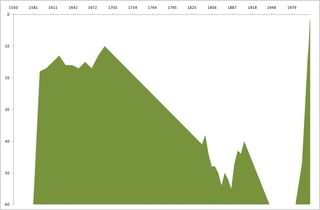
Let's just say, UK statistics from 1550-2007. Ranks. Graphs.
Grace:
 Isabel:
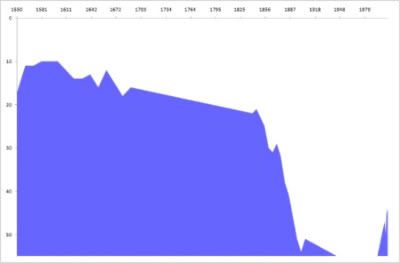 How to read the graphs:
Y (Left hand) axis = rank. #1 is most popular. If there is a gap then the name doesn't rank for that year. Lack of information for the early years means that I can't calculate % so the Mary graph is rather boring.
X axis = year. There are gaps in information from 1690-1840, and 1910-44 so that is why there are long straight joining lines between each.
They're not perfect. But they're decent, they're better than what there is already for the UK. And they make me happy.
Now, does anyone know where there are stats for the 1700s and interwar period?
Thursday, June 26, 2008
The Victorian Smiths in the 1870s
Post 5. To find out what this is all about, go here. Data.
1874-9:
Top 10:
| 1 | Mary |
| 2 | Ann |
| 3 | Elizabeth |
| 4 | Sarah |
| 5 | Alice |
| 6 | Annie |
| 7 | Emily |
| 8 | Ellen |
| 9 | Emma |
| 10 | Jane |
Ann has pushed past both Elizabeth and Sarah to be #2, Annie has gone up to #6. Emma has fallen down to #9.
There are quite a few names that peaked in this period, so I apologize about the length of this post, and apologize if some of the less popular names do not get the amount of exposure that they truly deserve. So the 'peaking' names are Emily, Louisa, Charlotte, Catherine and Isabella. Phew!
Start with Emily, as it's in the top 10. A Georgian name, one could say, as Withycombe states that it's rise to prominence came with George II's daughter Amelia being nicknamed Princess Emily. Borne by two notable unmarried writers - Emily Brontë and Emily Dickinson (though I don't think that Dickinson would have had much effect at the time, her poetry was not published until later).
Onto Louisa, it's 1870s peak is mentioned by Pickering in the Penguin Dictionary of First Names. Louisa is the Latinate form of Louise, whose bringing to prominence in England is usually attributed to Louise de Kérouaille, French mistress of Charles II. The name had been used in France for longer as a female form for Louis - eg Louise of Savoy, mother of 16th century French king Francis (or François) I. Louise was also the name given by Queen Victoria to her fourth daughter - Louise Caroline Alberta. Most of Louisas 'important bearers' seem to be Americans - author Louisa May Alcott and Louisa Adams - wife of American President John Quincy Adams - are the most prominent.
Charlotte is another very 'Georgian' name. It is French in immediate origin (ends up tracing back to Old German, but Charlotte is a French form) and the one of the first 'English' bearers was a French woman - Charlotte de la Tremoüille who married James Stanley, 7th Earl of Derby. However, its popularity really took off with the marriage of King George III to Charlotte of Mecklenburg-Strelitz in 1761. I assume that she was named after her father, who was a Charles. Anyway, Charlotte and George III added to the British contingent of Charlottes with their own daughter - Charlotte, later Queen of Württemberg. Their son, George VI, also had a Charlotte who, had it not been from her early death in childbirth, would have become Queen regnant of Britain. I think it's also necessary to mention the author Charlotte Brontë, born in the Georgian period but not famous until late 1840s. The fact that Charlotte has its peak in the 1870s rather than the 1840s or 50s does surprise me slightly and this may be a result of increased population by that time. Charlotte does have a fairly steady popularity until the 1870s, after which it declines noticeably.
Catherine. This was a name that I was surprised didn't have higher popularity. Whenever anyone mentions 'timeless' names my own mind leaps to Mary, Ann, Margaret, Elizabeth and Catherine. But it appears in Victorian times Catherine experienced popularity similar to Charlotte and Lucy rather than the very popular Mary and Elizabeth. From 1550 to 1700, Catherine or Katherine lingered around #10. Most of the influential bearers of the name of Catherine were much earlier than Victorian times - the 3 Catherine wives of Henry VIII - of Aragon, Howard and Parr, the French queen Catherine de' Medici, and Catherine the Great of Russia (died 1796 so closest to Victorian times). A contemporary Victorian bearer could be considered as Catherine Booth, wife of William Booth, the founder of the Salvation Army.
Isabella is a name that is currently receiving a lot of attention, in Victorian times it had a fairly steady popularity among the Smiths - having a range of less than 100 births. The Queen of Spain at the beginning of the Victorian period was Isabella II, though she abdicated in 1868. It is the Latinate form of Isabel. Historically borne by several 'strong' queens - Isabella of Castile and Isabella of France, wife of Edward II of England - 'she-wolf of France'.
1875-9:
Top 10:
| 1 | Mary |
| 2 | Ann |
| 3 | Elizabeth |
| 4 | Sarah |
| 5 | Alice |
| 6 | Annie |
| 7 | Florence |
| 8 | Edith |
| 9 | Ellen |
| 10 | Emily |
No changes to the top 6, but two new interesting entries at 7 and 8. I see this as the emergence of the names that will define the late Victorian period - Florence and Edith. This also marks the disappearance of Jane from the top 10 and Emma - they are now down at #13 and 14.
There are so many names that peak in this period, so again, I apologise for the length of this post. Ann, Alice, Ada, Margaret, Clara, Kate, Frances, Lucy, Isabel and Eleanor. So, lets get on with it.
Ann. I have examined most of the Biblical background to Ann in Hannah. Anne or Ann was consistently #3 in the period 1600-1700, and only rose up a few places from 1550 to reach this spot. Most of the royal Anns are from the period 1450 to 1650 - Anne of Brittany, Anne of Cleves and Anne Boleyn - wives of Henry VIII, Anne of Denmark - wife of James I of England and VI of Scotland, Anne of Austria - wife of Louis XIII of France and mother of Louis XIV, the 'Sun King'. In Britain, Queen Anne reigned from 1702 to 14, and was the last of the Stuart dynasty. Closer to the Victorian period, it was borne by Ann Radcliffe - Gothic author and author Anne Brontë.
Alice. A name that was fairly prominent in the Medieval period, though was later overshadowed by more 'religious' names - Mary, Ann, Elizabeth. George Redmonds lists Alice as the most popular name in the period 1377-81, and it appears as #3 in 1550-9, then declining into the lower echelons of the top 10, and finally as #12 in 1690-1700. As seen here, Alice has risen into the #5 spot. Withycombe states that the name was regarded as old-fashioned and country in the 17th century, but was revived in the 19th century. For a more modern example, I'm thinking Abigail - fell out of favour in the 19th century as a maid's name, but is now experiencing a strong revival in the USA. Anyway, 19th century examples of use include Queen Victoria's second daughter, Alice of Hesse, born 1843, 'Alice's Adventures in Wonderland' by Lewis Carroll, published in 1865 - the Alice being named after Alice Liddell, born 1852, and the Australian town of Alice Springs - formed due to the opening of the Overland Telegraph Line in 1872, and the discovery of alluvial gold in 1887, 100km to the east of the town. Alice Bell (born roughly 1837) was the wife of Charles Todd, who helped set up the telegraph lines. More on Alice.
Ada. Personally, I associate Ada with Ada Lovelace, daughter of Lord Byron, who described Charles Babbage's early 'computer' - the analytical engine. Ada was a name imported by the Germans - through the Georgian kings, a name in it's own right and a nickname for Adelaide - the name of William IV's wife. More on Ada.
Margaret. I consider Margaret to be a heavyweight timeless name - along with Elizabeth, Mary, Ann and Catherine. However, it's probably the name that is on the periphery of that group. It's heavy consonants have not translated wonderfully into this new Millenium, but is still experiencing use due to its variety of nicknames - Maggie, Margie, Peggy, Megan etc. Early use was due to its popularity as a non-Biblical religious name - borne by the childbirth patron saint Margaret of Antioch. It experienced especial use in Scotland where it was borne by the 11th century Scottish queen St Margaret. Withycombe states that Margaret was out of fashion in the 16th to 18th centuries, and revived in the 19th century. Margaret's high point in the Redmonds lists were from 1580-99 when it was #2, below Elizabeth. Fro, 1660-1700 it was #6. It appears as #10 in 1860-4, but by 1875-9 is #12.
Clara. Latin form of Clare, according to Withycombe arrived in England in the 13th century as both Clara and Clare (I think the assumption that Clares were called Clara on Latin documents, similar to Marys being Marias). Clara then came into fashion in the 19th century - there are a few sympathetic characters in Dickens' David Copperfield (published 1850) named Clara.
Kate. Nickname for Catherine, a common nickname in the 16th and 17th centuries, and then revived again in the middle of the Victorian period. At the beginning of the period, Kate has very few usages - not unknown but there is a big difference between 11 and 413 births, by the end it has declined from its peak.
Frances. I have been through Fanny, so Frances is fairly similar. Appeared in the Tudor period, often used to honour a male Francis (eg Frances Brandon in honour of her godfather Francis I of France). In the Redmonds list, Frances appears at the bottom - around #18 from 1600-1700. Its highest point is #13 in 1690-1700.
Lucy. Became popular due to St Lucy of Syracuse, a popular Medieval saint - so popular in Medieval times. Dunkling and Gosling state that it had a peak in Britain in the 1870s - obviously supported by this Smith data, and this was followed a generation later in USA (which does beg the question - how long is a generation?). Most of the notable bearers I can find are pre- or post-Victorian - Lucy Lockit in 'The Beggar's Opera' - first performed in 1728, Lucy Maud Montgomery, author of the 'Anne of Green Gables' series - born 1868 but 'Green Gables' was not published until 1908, and Lucy Westenra from Bram Stoker's 'Dracula' - just in the period by 4
years as published in 1897.
Isabel. Having recently read 'The Portrait of a Lady' by Henry James, I associate this name with Isabel Archer. Obviously the name has a history prior to 1880-81 when that novel was serialised. Came to England in the 12th century, and used interchangeably with Isabella and Elizabeth until 16th century. On the Redmonds list, Isabel is #10 from 1560-1600, and then declines from 1600 to 1700 to the bottom half of the top 20. More on Isabel.
Eleanor. Traditionally considered to have been brought to England by Eleanor of Aquitaine, and popularised by Eleanor (or Leonor) of Castile. Eleanor pops up and down between 10 and 20 in the Redmonds lists from 1550-1700, making it difficult to make and solid conclusions there. With the Smiths, Eleanor stays fairly consistently 'popular' (or more 'recognisable' - not super-popular, not uncommon) gaining less than 100 births between its trough and peak. More on Eleanor.
Monday, May 14, 2007
Helen, Ruth, Lyra, Eleanor and Isabel
Helen
Popularity:
17 girls were named Helen in Scotland in 2006
10 girls were named Helen in Sweden in 2004
There are 2599 people in Norway called Helen, 4 of which were born in 2006
#343 in USA, 2006 - it's peak was between 1900 and 1919 when it was #2 name
Helen is not an approved name in Portugal, but Helena is
Meaning:
Greek - 'bright, shining one'
Characters and Usage:
In Greek mythology, Helen is the beautiful daughter of Zeus and Leda, whose abduction by Paris brought about the Trojan War.
There is a place in Georgia, USA called Helen, with 430 residents.
There are several actresses named Helen: Helen Hunt, Helen Hayes, Helen Mirren and Helen Slater.
Helen Clark is the Prime Minister of New Zealand.
Helen Keller was a death and blind woman, who was the first death-blind woman to graduate from college.
Ruth
Popularity:
17 girls were named Ruth in Scotland in 2006
10 girls were named Ruth in Sweden in 2006
628 people named Ruth in Argentina (Buenos Aires)
There are 11524 people in Norway called Ruth, 18 of which were born in 2006
#373 in USA, 2006 - it's peak was 1908-9 when it was #4 name
Ruth is not an approved name in Portugal
Meaning:
Thought to come from the Hebrew re'uth meaning compassion or friend. In English, ruth is a noun meaning 'pity' or 'sympathy' - and is most commonly used as the form 'ruthless'.
Characters and Usage:
Biblically, Ruth was the Moabite protagonist of the Book of Ruth, who after her husband dies, chooses to stay with her Jewish mother-in-law Naomi rather than return to her homeland. She later marries Boaz, and is one of the ancestors of David, and subsequently Jesus.
Ruth is a symbolic name for girls born on the Jewish month of Shavuot (corresponding with late May-early June), when the Book of Ruth is read in the synagogue.
Ruth is the name of two craters - on the Moon, and on Venus.
Ruth is a novel by Elizabeth Gaskell.
Lyra
Popularity:
1 girl was named Lyra in Scotland in 2006
There are 6 people in Norway called Lyra
Lyra is not an approved name in Portugal, but Lira is
Meaning:
Greek - lyre
Characters and Usage:
Lyra is a constellation in the Northern Hemisphere, containing the star Vega, third brightest in the Northern sky. Vega will become the Pole Star in approximately 14 000 AD due to the progression of the equinoxes. Lyra was named so as it is in the shape of a lyre, one theory being that it is the lyre of Orpheus.
from Wikipedia.org 
Lyra is one of the protagonists in Philip Pullman's 'His Dark Materials' trilogy
Eleanor
Popularity:
#42 in England and Wales, 2006
35 girls were named Eleanor in Scotland in 2006
There are 63 people in Norway called Eleanor
#277 in USA, 2006 - it's peak was in 1920 when it was #25 name
Eleanor is not an approved name in Portugal, but Eleonor is
Meaning:
From the Provence name Aliénor, with an obscure meaning. In langue d'Oc of the Provence region, this means 'another Aenor' - possibly relating to Eleanor of Aquitaine, an early bearer, whose mother was named Aenor. Aenor is related to the Greek Eleonore from eleos meaning 'pity' and the Arabic Ellinor - 'God is my light'.
Characters and Usage:
There have been several queens named Eleanor - in particular:
Eleanor of Aquitaine - wife of Louis VII of France, and Henry II of England
Leonora of England - wife of Alfonso VIII of Castile
Eleanor of Castile - wife of James I of Aragon
Eleanor of Provence - wife of Henry III of England
Eleanor of Castile - wife of Edward I of England
Eleanor of Castile - wife of Alfonso IV of Aragon
Eleanor of Castile - wife of Charles III of Navarre
Eleanor Roosevelt was the wife of Franklin D Roosevelt, American President
Eleanor Dashwood is one of the heroines of Jane Austen's 'Sense and Sensibility'
Eleanor has been in the title of songs by:
The Beatles - Eleanor Rigby
Franz Ferdinand - Eleanor Get Your Boots On
Jet - Eleanor
Isabel
Popularity:
#69 in NSW, Australia, 2006
#44 in England and Wales, 2006
13 girls were named Isabel in Scotland in 2006
#46 in Spain, 2005
79 girls were named Isabel in Sweden in 2006
#76 in Chile, 2005
4698 people named Isabel in Argentina (Buenos Aires)
There are 976 people in Norway called Isabel, 70 of which were born in 2006
#87 in USA, 2006 - it's peak was in 2003 when it was #83 name
Isabel is not an approved name in Portugal, but Isabela is
Meaning:
From Elizabeth -Hebrew- 'my God is a vow'
Characters and Usage:
There has been a large number of queens and monarchs named Isabella, but few named Isabel (with no elle).
Isabel Martinez de Peron was the third wife as Juan Peron and served as Argentinian president 1974-6.
St Isabel of France was a daughter of Louis VIII of France and Blanche of Castile. She founded the Abbey of Longchamp, but never became a nun. When her body was exhumed 9 days after her death it showed no sign of decay.
There are several towns (including 3 in the USA) called Isabel.
Hurricane Isabel was a category 5 hurricane in 2003, causing $3.6 bil of damage
Wednesday, July 26, 2006
Elizabeth and its diminutives and alterations
Elizabeth
History: Elizabeth is a fairly common throughout history. It is of Hebrew origin from Elisheva - 'God is my oath'. In the Bible Elisheba was Aaron's wife and John the Baptist's Mother (who is now known as Elizabeth).
An early recording of Elizabeth is a Russian Princess Elisavetta who was sang about by Viking king Harald Hardrada. The songs established the name in Scandinavia and so came the alterations: Elsebin, Lisbet and Helsa.
Changing of Elizabeth:
Elisheba to Elisabet by the Greeks
Elisabet to Elisabeth in Latin
Elisabeth to Lescinska by the Russians
Elisabeth to Elizabeth by the Germans
And Elisabeth to Isabelle in the 12th century
Isabel
Creation in a nutshell: Belgian Princess Elizabeth married Philippe August of France and changed her name to Isabella. This became Isabelle, Isabel and Ysabel.
Nicknames
Elizabeth = Ellie, Ella, Eliza, Elsie, Elspeth, Elise, Liz, Liza, Lizzie, Libby, Lisette, Lilibet, Beth, Bet, Betsy, Bess, Bessie, Bettina, Babette, Betty, Bella, Belle, Izzy
Elisabeth also gives Lisa and Lissie
So what do I think of Elizabeth?
1) Terrific numbers of nicknames and alterations eg Isabel, even if Elizabeth is common the vast amounts of nicknames means that an Elizabeth will not get lost in the crowd. The only names with similar scope that I can think of are Alice (because of all the different Alicia spellings) and Katharine/Katherine/Catherine/Catharine/Kathryn.
2) Huge numbers of namesakes as well - Elizabeth, mother of John the Baptist, Elizabeth I and II of England, several St Elizabeths, for celebrities there's Liza Minnelli, Bette Midler and Elizabeth Taylor. Also included in plays and literature such as Eliza Dolittle in Pygmalion and My Fair Lady.
3) However, I also think that Elizabeth is common and can be plain. I consider Isabel to be a prettier alternative, especially in the middle name spot. However, Isabella is rising sharply in popularity - last year it was #6 in the USA. But Elizabeth is a safe choice - unlikely to attract the kind of teasing that other 'made-up' and 'unique' names will, and will last a lifetime.
Subscribe to:
Posts (Atom)