CLICK HERE FOR BLOGGER TEMPLATES AND MYSPACE LAYOUTS »
Showing posts with label uk. Show all posts

Sunday, April 21, 2013

Research Sunday: Names in Workhouses of the 1881 census

Following my post on Names and Status in the 1881 census, I've been thinking about how else status can easily be seen in the 1881 census. In my previous post, I looked at 'masters' and 'servants', and how that situation implies higher and lower status. When one speaks of 'low status', you couldn't get much lower in Victorian Britain than the workhouse. Workhouses were places where people who could not support themselves could live and have employment. Whilst they provided relief for the poor, life inside workhouses was intended to be harsh - you had to be destitute and desperate.

I found that http://www.workhouses.org.uk/ have transcribed the 1881 census and put it into tables - making it easy to copy and order the relevant data in Excel. I chose to look at workhouses situated in London, mainly the East End, for my sample. The workhouses I sampled were:

This provided me with 4011 records,which can be broken down into 2002 men and 2009 women, a fairly even split, although I think some of the records have the wrong gender assigned (eg a female Thomas Collins and a male Rebecca Stockley). I ended up with 1994 male and 1994 female named people (some did not have a name recorded). As I was able to copy the tables, this is a study that could be easily expanded or replicated - but I stopped with 4011 as that is a workable amount to count the names.

I worked out the order of the names, the % of the total who bore that name and then have compared them with 1881 census data for the general population.

Their top 20s are as followed:
Male

Rank Rank compared with 1881 census total Name Workhouses Count % % compared with 1881 census total
1 = William 346 17.35 +4
2 = John 289 14.49 +2.1
3 = Thomas 171 8.58 +0.7
4 +1 James 155 7.77 +1.2
5 -1 George 139 6.97 0
6 = Henry 120 6.02 +1.4
7 = Charles 93 4.66 +0.6
8 = Joseph 73 3.66 +0.3
9 +1 Edward 55 2.76 +0.2
10 +1 Frederick 54 2.71 +0.3
11 -1 Robert 48 2.41 -0.3
12 +3 Samuel 46 2.31 +0.5
13 = Richard 41 2.06 +0.1
14 -2 Alfred 34 1.71 -0.3
15 +11 Daniel 27 1.35 +0.9
16 +8 Benjamin 25 1.25 +0.6
17 = Albert 22 1.10 -0.2
18 -4 Arthur 20 1.00 -0.9
19 -1 David 16 0.80 -0.3
20 -4 Walter 14 0.70 -0.7

This top 20 is fairly concordant this is with the 1881 general population census data. Apart from a little swapping around, and Benjamin and Daniel being much more popular at #15 and #16, there isn't much of a difference. The most notable difference is that this top 20 counts for a larger percentage of the names used than the general population census data. (89.67% of workhouse males had names in this top 20 compared with 80.4% of the general population having a top 20 name). 

The majority of the population is low status (that's generally how status works) and as the general population census data reflects the names popular among the majority, it reflects the names that are popular among those of 'low status', diluted slightly by names that might have a strong regional identity (such as Malcolm, popular in Scotland - I think a great further study would look at names that show strong regionality). 

The male name that seemed more 'high status' in my previous study - Frederick - is in about the same position as in the general population here. James and George, which were more 'low status' are in about the same position as the general population as well. In general then, the names borne by males in the workhouses seem to reflect the names that were popular among the general population.

A wordle (I copied in full names, hence why you might be able to see popular surnames such as Smith and Brown in the background):

Benjamin and Daniel
A quick word on Benjamin and Daniel, as they are the two names that do show a significant increase in popularity from the 1881 census data. Benjamin covers most ages (there are no 20-30 year old Benjamins, but there are 10 year olds and 60 year olds), all the workhouses and are mostly born in and around London.
Daniel however, is borne almost exclusively by 40+ year olds and includes five men whose birthplace is listed as Ireland. It is the second most popular name (after John) of men whose birthplace is listed as Ireland, so that might account for its increased popularity - that a significant number of men born in Ireland ended up in east London in 1880s.

Females

Rank Rank compared with 1881 census total Name Workhouses Count % % compared with 1881 census total
1 = Mary 321 16.10 +3.1
2 = Elizabeth 211 10.58 +2.3
3 +1 Sarah 162 8.12 +1.7
4 -1 Ann 153 7.67 +1.1
5 = Jane 79 3.96 -0.7
6 = Ellen 79 3.96 +0.9
7 = Eliza 71 3.56 +0.8
8 +3 Margaret 53 2.66 +0.3
9 +1 Emma 51 2.56 -0.1
10 +7 Catherine 49 2.46 +1.3
11 +4 Louisa 42 2.11 +0.8
12 -4 Alice 41 2.06 -0.7
13 +11 Caroline 40 2.01 +1.1
14 -1 Hannah 34 1.71 -0.3
15 +2 Maria 33 1.65 +0.4
16 +15 Susan 32 1.60 +1
17 -5 Emily 28 1.40 -0.7
18 +2 Charlotte 27 1.35 +0.3
19 +10 Frances 27 1.35 +0.7
20 -2 Harriet 26 1.30 +0.1
While the top 7 is fairly concordant with the general population top 7, the rest of the top 20 is full of movement. Some names have risen dramatically (Catherine, Caroline, Susan, Frances), others have dropped into obscurity (Annie has dropped 16 places to #25, Edith is #19 in the general population but only has one workhouse bearer).  Again, as with the male names, this top 20 accounts for a larger % of the names borne than the general population - 79% compared with 68% (and note, as almost always, this shows there is more variety in female names than male names). 

Margaret
A note on Margaret. In my previous 1881 post, I found that Margaret was more likely to be borne by the higher status individuals ('masters') than the lower status ones ('servants'). However, this study shows that it was borne by more workhouse inmates than among the general population. I wondered if this was a regionality thing - that more London-born people were named Margaret, but as many of the workhouse Margarets were born in Ireland, then this seems less likely. 

Catherine, Caroline, Susan, Frances
Most of the Catherines, Susans, Carolines and Frances are 40+, indeed, much of the workhouse population is 40+, as workhouses became places where the destitute elderly who could not work to support themselves could end up. My Victorian Smiths studies showed that all these names peaked in the 1840-50s (and probably earlier, as I was not able to study beyond 1840). So they are more popular amongst the 40+ year olds than the younger inmates. 

Names that experienced steeper popularity curves - were less popular in 1840s and more popular around 1880 - such as Alice, Edith, Annie, Emily, Florence (#38 compared with #21 general, and would be #1 or 2 by 1900), Beatrice (no workhouse entries) and Maud (2 workhouse entries) are all less popular in the workhouse, reflecting the lower numbers of young people in the workhouse and perhaps, the fact that once in the workhouse, women were unable to produce and support large numbers of children. Mary would be the name for a first child, Elizabeth for the second but they wouldn't get to the fifth or sixth child which they could name a more unusual name such as Florence or Beatrice.

An exciting chart based on my Victorian Smiths data:
Hannah, Harriet and Martha don't follow this general trend, but only Martha is significantly less popular amongst the workhouse population.

A wordle (I think Elizabeth looks a bit small compared with Ann because it is such a long name):


Thursday, March 18, 2010

Names and Authenticity in Historical Fiction (1980s)


This is part 3 of the Names and Authenticity in Historical Fiction, meant to be helpful posts to see if a name chosen for a novel is particularly apt or jarring for fiction set in the 1980s. The 1940s can be found here, and the 1960s can be found here
UK:
Popular: Sarah, Laura, Gemma, Emma, Rebecca, Claire, Victoria, Samantha, Rachel, Amy, Jennifer, Nicola, Katie, Lisa
Emerging: Lauren, Emily, Sophie, Jessica, Holly, Jade, Eleanor, Abigail, Alice, Georgina, Chloe
Dated: Anne, Mary, Jacqueline, Christine, Jane, Susan, Anita, Ann, Beverley, Carol, Denise, Diane, Gillian, Janet, Linda, Patricia, Sandra, Sharon, Tracy
USA:
Popular: Jessica, Jennifer, Amanda, Ashley, Sarah, Stephanie, Melissa, Nicole, Elizabeth, Heather, Tiffany, Michelle, Amber, Megan, Amy
Emerging: Emma, Hannah, Olivia, Abigail, Alexis, Alyssa, Brianna, Jasmine, Morgan, Julia
Dated: Susan, Linda, Donna, Sandra, Deborah, Tammy, Pamela, Lori, Brenda, Barbara, Sharon, Debra, Teresa, Nancy, Cheryl
France:
Popular: Aurélie, Émilie, Céline, Virginie, Élodie, Audrey, Stéphanie, Julie, Laetitia, Sabrina, Mélanie, Jennifer, Laura
Emerging: Alice, Alicia, Alison, Cassandra, Charlotte, Clémence, Émeline, Gwendoline, Juliette, Laurène, Lucie, Marie, Maxime, Mélissa, Pauline, Priscilla, Sarah, Solène
Dated: Agnès, Anne, Béatrice, Carole, Catherine, Christelle, Christine, Corinne, Delphine, Fabienne, Fabrice, Florence, Isabelle, Karine, Magali, Muriel, Nadine, Nathalie, Pascale, Patrice, Patricia, Sabine, Sandra, Sandrine, Séverine, Sonia, Sophie, Stéphanie, Sylvie, Véronique
Australia (Victoria):
Popular: Sarah, Jessica, Rebecca, Melissa, Lauren, Emma, Nicole, Amanda, Kate, Laura, Michelle, Amy, Lisa, Stephanie, Samantha
Emerging: Olivia, Chloe, Sophie, Zoe, Lucy, Caitlin, Ashleigh, Ashlee
Dated: Susan, Karen, Julie, Sharon, Leanne, Helen, Debra, Wendy, Sandra, Linda, Tracey, Robyn, Donna, Deborah
Norway:
Popular (peaking): Camilla, Caroline, Hanne, Iselin, Karoline, Kristine, Line, Lisa, Mari, Maria, Sandra, Silje, Stine
Emerging (growing): Amalie, Amanda, Andrea, Aurora, Eline, Elise, Emilie, Hanna, Helene, Hilde, Ida, Ingrid, Julia, Julie, Kaja, Malin, Maren, Marte, Martine, Oda, Pernille, Ronja, Sara, Sarah, Sofie, Sunniva, Synne, Thea, Tiril, Victoria, Vilde
Dated (declining): Anita, Ann, Anne, Bente, Elin, Ellen, Eva, Hege, Heidi, Irene, Kristin, Lene, Linda, Marianne, May, Mette, Mona, Monica, Nina, Tone

Tuesday, February 02, 2010

Names and Authenticity in Historical Fiction (1940s)


I'm sure if anyone reads historical fiction, they will know this point of contention. A female main character born in the 1940s named Addison or a group of friends born in the 1980s called Beryl, Clara, Daphne and Doris. All names that were known in the 1980s, but the probability that there would be no Sarah, Rebecca, Laura or Gemma in sight is highly unlikely, considering they were 4 of the most popular names in 1984 in UK.
Thus I present, the 1940s (yes, hopefully the first in a series). What was emerging and would become very popular in the next few decades (and was known in that period, not names that gain sudden popularity such as Addison), what was popular (the top 10/15/20), and what was dated and gone (past popular names, now sliding down the popularity charts). Data is from where it is available. Norway, USA and Victoria, Australia are online. UK is from 'First Names' by E. Merry and my own stats for 1900s to work out dated names, and France is from 'La cote des prénoms en 2007' by J. Besnard.
UK:
Popular: Margaret, Patricia, Christine, Mary, Jean, Ann, Susan, Janet, Maureen, Barbara, Valerie, Carol, Sandra, Pauline, Elizabeth
Emerging: Diane, Angela, Catherine, Yvonne, Helen, Elaine, Jane, Lesley, Maria, Lynda, Denise, Marian, Teresa, Sally, Sarah, Julie, Caroline, Lorraine, Lynn
Dated: Mary, Elizabeth, Dorothy, Frances, Marjorie, Evelyn, Emily, Vera, Alice, Lillian, Phyllis, Doris, Florence, Ellen, Annie, Edith, Elsie, Gladys, Hilda, Ivy, Lily, Winifred
France:
Popular: Monique, Nicole, Danielle, Michèle, Jacqueline, Françoise, Jeannine, Christiane, Marie-Thérèse, Josette, Annie, Chantal, Anne-Marie, Martine, Arlette, Claude, Claudine, Éliane
Emerging: Martine, Dominique, Brigitte, Catherine, Sylvie, Patricia, Annick, Béatrice, Élisabeth, Fabrice, Florence, Ghislaine, Isabelle, Myriam, Nadine, Pascale, Sabine
Dated: Marie, Jeanne, Marguerite, Marie-Louise, Germaine, Yvonne, Madeleine, Louise, Suzanne, Marcelle, Alexandre, Alice, Camille, Joséphine, Juliette, Lucie
USA :
Popular : Mary, Linda, Barbara, Patricia, Carol, Sandra, Nancy, Sharon, Judith, Susan, Betty Carolyn, Margaret, Shirley, Judy, Karen
Emerging: Michelle, Cynthia, Deborah, Pamela, Laura, Julie, Jennifer, Angela, Debra, Teresa, Christine, Denise
Dated: Anna, Florence, Mildred, Ethel, Lillian, Gladys, Edna, Emma, Bertha, Minnie, Bessie, Grace, Mabel, Ida, Gertrude
Australia (Victoria):
Popular : Margaret, Judith, Helen, Patricia, Lynette, Barbara, Pamela, Lorraine, Beverley, Jennifer, Sandra, Elizabeth, Janice, Mary, Joan, Heather
Emerging: Robyn, Christine, Cheryl, Dianne, Karen, Vicki, Kerry, Debra
Dated: Dorothy, Valerie, Betty, June, Joyce, Jean, Lorna, Norma, Valda, Thelma, Audrey
Norway:
Popular (in this case, not necessarily the most popular names, but the names that peaked in the 1940s): Gerd, Grete, Inger, Jorunn, Kari, Karin, Kirsten, Marit, Randi, Reidun, Turid, Unni
Emerging: Anita, Ann, Anne, Aud, Berit, Eli, Elin, Elisabeth, Eva, Hilde, Marianne, May, Mette, Mona, Sissel, Tone, Tove, Wenche
Dated: Agnes, Alma, Aslaug, Borghild, Ella, Gudrun, Gunvor, Helga, Inga, Ingeborg, Ingrid, Johanne, Karen, Karoline, Klara, Kristine, Maren, Margit, Marie, Martha, Mary, Mathilde, Olga, Ragnhild, Ruth, Signe, Sigrid, Sofie, Solveig

Tuesday, September 08, 2009

Hurrah - England and Wales stats are back

Here and here.


A few changes from before - they are published by ONS rather than GRO (Office of National Statistics instead of General Register Office, so may differ slightly from before. There is the ONS data from 1998 and 2007 as well, but a gap between '99 and '06.

Jack and Olivia are number one, while Ruby was, according to this data, #1 in 2007. Ffion, Seren and Megan are in the top 10 in Wales. In particular interest are the tables that list most popular names for each month - Holly is #1 in December and Summer is in the top 10 in June, July and August.

Dylan and Rhys are in the top 10 in Wales, a quick glance doesn't reveal any large monthly variations on names given. Regional information is also interesting - Mohammed is #4 in Yorkshire and the Humber, #3 in London and #2 in West Midlands but doesn't appeal at all in the top 10s for E Midlands, N East, E England and S East.

New entries to top 100 include: Lexi (fastest mover), Florence, Emilia, Maryam and Esme, and Blake, Ewan and Zak. Other quick climbers include: Evie (from #15 to #10), Ava (#39 to #21), Summer (#44 to 23), Isla (#65 to 36), Matilda (#62 to 43) and Lacey (#77 to 60), and Oscar (#41 to 30), Riley (#57 to 33), Alex (#58 to 47), Theo (#73 to 58) and Leon (#74 to 62). As ever, there seems to be fewer dramatic changes in the boys list than there is in the girl's list.

Fast fallers include: Amy (#23 to 34), Caitlin (#34 to 44), Georgia (#42 to 52), Madison (#36 to 56), Rebecca (#47 to 64), Maddison (#63 to 74), Skye (#67 to 77), Aimee (#76 to 86) and Courtney (#79 to 98), and Cameron (#34 to 46), Jamie (#36 to 51), Ben (#48 to 57), Kyle (#51 to 69), Kieran (#61 to 73), Aidan (#78 to 92) and Billy (#89 to 98). Is it just me, or is there a Scottish/Irish flavour to these falling names? Callum, Connor, Finlay and Sean have also fallen. But Ryan, Liam and Finley have all risen.

Also interesting are new entries from 1998, names that have become top 100 in 11 years include: Ruby, Evie, Ava (rose 508 places), Summer, Isla (333 places), Scarlett, Eva, Brooke, Matilda, Keira, Lola (322 places), Lilly, Gracie (529 places), Madison, Amelie (2641 places!), Lacey, Sienna (1060 places), Libby, Layla, Maya, Lexi (4917 places!), Maddison, Sofia, Skye, Lexie (4911 places!), Faith, Martha, Eve, Julia, Evelyn, Maria, Tilly, Florence, Emilia, Maryam and Esme.

Jayden, Oscar, Archie, Riley, Lucas, Leo, Finley, Logan, Noah, Mason, Theo, Freddie, Finlay, Harley, Kian (436 places), Hayden, Zachary, Luca, Ashton, Bailey, Sebastian, Gabriel, Evan, Taylor, Reuben, Blake, Louie, Ewan and Zak. There are much fewer dramatic rises for the boys.

Fallen out of the top 100 are: Rose, Victoria, Rachel, Shannon and Madeleine, and Andrew, Frederick and Dominic.

Sunday, May 10, 2009

Emma

It has been a while since I have written a post on a single name, but with Emma being crowned the most popular US female name, overthrowing Emily, I thought that this was deserved. Anyway, for such a short name, Emma has some interesting history.

I'll start with a comparison:
Emma in the UK:

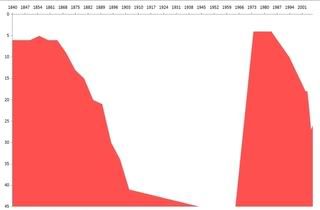
Here in Britain, Emma's on a downwards turn - particularly popular in the 1970s and 80s when the name was #4, and the 1840s-70s when Emma was in the top 10. In the 2007, Emma charted at #26 - not unheard of, but not the popularity experienced in USA.

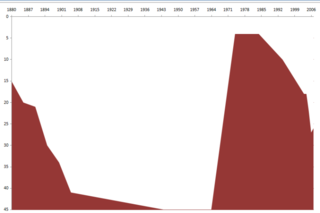
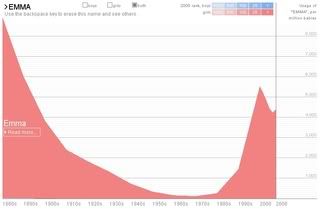
USA (I'm being a little lazy and using a screenshot from Laura Wattenburg's fantastic Name Voyager - if you're really interested in Emma's graph, then this great tool allows you to check out the # in certain decades. The Name Mapper is also quite awesome - Emma seems to have originated in terms of popularity in the NE/New England area). 

Though Emma is #3 in 1880s, this counted for a larger percentage of babies compared with today. It fell to #448 in 1970s, before rising to #2 in 2000s, and #1 in 2008.

It's a bit of an unfair comparison to show the US data, which runs from 1880 to 2008, with my UK data, which runs from 1840 to 2007. To try and rectify that, I've cut the UK
 data back to 1880 (bare in mind that 1910-44 I have no data, so have no idea what Emma was doing!)


In both countries, Emma falls from a high position in 1880, to obscurity in the early 20th century. However, in the UK, Emma rises back to popularity in 1970s, whereas it is in its deepest trough in the US at that point. Obviously, Emma's cycle of popularity in the UK is shorter than in the US, or at least, shifted to a different era.

So, where to begin with Emma?

With most names, people tend to associate names with a particular person or thing. Some will be universal - a literature, historical, movie, celebrity reference, others will be more personal - mother, girl from school, friend's daughter etc. For me, Emma is associated primarily with Emma of Normandy, wife of two rather differing kings of England.

Emma was a political pawn - a way of these kings of England to cement an alliance with Normandy. Her first husband was Aethelred the 'Unready', the second was his opponent Cnut the 'Great' of Denmark, who conquered England. Emma was known in England as Aelfgifu - which was also the name of the first wives of Aethelred and Cnut, but is primarily known by her first name, Emma, now due to her biography: the Encomium Emmae. This highly selective work ignores her marriage to Aethelred, though is happy to highlight the rise of her son by him, Edward the Confessor. Emma is also one of the very few, if only, person living before the Norman Conquest whose residence can be located - God Begot House in Winchester, which is now a pizza restaurant. She was, for the period, a highly remarkable woman and compared with other women from the period, she was highly visible in records.
What is the point of writing about Emma of Normandy? Well, she introduced the name to England, where it was used throughout the Middle Ages, particularly in the one syllable form of Emm. My assumption is that like the other popular female name from pre-Norman conquest England, Edith, Emma was superceded by Biblical names such as Mary, Sarah and Elizabeth from 12th century onwards. Redmonds has a list in his 'Christian Names in Local and Family History' which has found the most popular names from some records (poll tax? I think) from 1377-81, where Emme comes in #6 - above Sarah, Elizabeth and Mary. Other Emmas from before the 18th century revival of the name include Emma of France, daughter of Robert I; Emma of Italy, daughter of Lothair II and mother of Louis V of France; Emma of Provence, daughter of Rotbold III; Emma of Hauteville, daughter of Robert Guiscard; Emma de Guader, Countess of Norfolk and daughter of William Fitz-Osbern; St Emma of Lesum; St Hemma of Gurk and Emma of Altdorf, wife of Louis the German.

We now have to skip forward to 1761 and the birth of another Emma. Or Emy, as Emma, Lady Hamilton was born, she later adopted the name Emma. The mistress of Lord Nelson, Emma was the first in a group of 18th century namesakes. I've mentioned this before, but E.G. Withycombe attributes Emma's reburst of popularity to the poet Matthew Prior (1664-1721), who wrote the poem Henry and Emma. Though Emma Hamilton was the first of a group of famous Emmas, that does not necessarily mean that she was original in her new name choice.

Another 'Emma' that precedes Emma Hamilton was Emmanuel College, Cambridge, founded in 1584 and known today as 'Emma'. Whether it was known as Emma prior to the revival of the name is not known by me. 

I'm going to move onto the Emma now, that novel by Jane Austen. A brief interlude, to stay somewhat chronological, is to say that Emma Darwin, wife of Charles, was born in 1808 into the Wedgwood family. However, she was no child prodigy, so if she had any effect on the popularity or perception of the name, it would not occur until later in her life.

Emma Woodhouse, of Emma, written 1815, is a striking, beautiful, witty heroine who is a disastrous matchmaker. Despite her matchmaking failures, the book has been extremely popular.  Emma also appeared as Emma Bovary in Flaubert's 1857 Madame Bovary, but by then the name was fully revived.

Thinking about Emma's revival in Britain in the 1970s, I'd like to propose that Diana Rigg's character Emma Peel in The Avengers was at least partly responsible. The name was a play on M Appeal or Man Appeal, rather than an effort to revive the name of Emma Woodhouse, Hamilton and Bovary. Emma Peel first appeared in 1965 - as my data comes from 1964, then the sudden change to not being in the top 100 in 1964, to #4 in 1974 is very obvious. 


Nowadays, there are numerous pop culture and celebrity references that can be used to try and explain the popularity of Emma: perhaps it's actress Emma Thompson, Spice Girl Emma Thompson or Ross&Rachel's daughter in Friends. Or maybe it's none of them: it is conceivable that American audiences have become accustomed to Emma as not being primarily associated with anything in particular at the moment. Emma's historical, literary and pop culture, whilst not being overwhelmingly any of those. 

Will Emma stick at the top in the US?
Hmm, well there was only 200 births between Isabella and Emma, and as pointed out by Laura Wattenburg, if Emma had had that number of births in 2007 it would only have been #3 - there by the grace of the decline of Emily and Isabella. But Emma didn't fall last year - it has been but it increased by 300 births between 2006 and 7. It very much seems that Emma's position depends on its neighbours - Isabella could still push up to the top, or perhaps Sophia - which is the most popular name in terms of sound. Emily does however, seem on the way down. Roll on 2009!

Saturday, April 04, 2009

This makes me happy.

Short post. Mainly because I'm not sure how to write out how this all works.


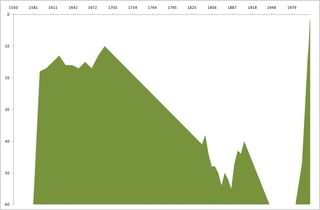
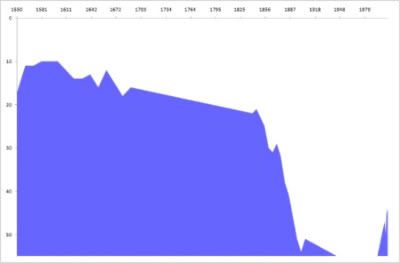
Let's just say, UK statistics from 1550-2007. Ranks. Graphs.

Grace:
Isabel:How to read the graphs:
Y (Left hand) axis = rank. #1 is most popular. If there is a gap then the name doesn't rank for that year. Lack of information for the early years means that I can't calculate % so the Mary graph is rather boring.
X axis = year. There are gaps in information from 1690-1840, and 1910-44 so that is why there are long straight joining lines between each.

They're not perfect. But they're decent, they're better than what there is already for the UK. And they make me happy.

Now, does anyone know where there are stats for the 1700s and interwar period?

Saturday, March 07, 2009

The Victorian Smiths - how realistic?

So I have acquired the top 20 for the 1881 census, and what do I want to do with it? Compare it with the Victorian Smiths of course!

If you want to know about censuses in the UK then there's a wikipedia page, and things on the Office for National Statistics and GENUKI. The 1881 census is the only one that is available completely free and can be searched on Family Search. The top 20 list that I have is from an article by Dr Kenneth Tucker published in Onoma, the actual article has a lot more information and analysis.


What does this mean? Well, the 1881 census includes pretty much everyone alive in 1881 - so they could be born in 1852 or 1820 or 1881 itself (as long as it's pre April), so I've added up all of the totals. Unfortunately, this excludes everyone born pre-1840 or born outside of UK. But as the life expectancy was lower than it is today (around 40-50 seems to be what I am finding) then this should affect it less than if it was studying the 2001 census where the life expectancy is longer. Also, there was an increase in population (14 mil to 24 mil 1840-80) that means that a significant proportion of the population will be under 40.

Anyway without further ado:
1881 census:

1

Mary

2

Elizabeth

3

Ann

4

Sarah

5

Jane

6

Ellen

7

Eliza

8

Alice

9

Annie

10

Emma

11

Margaret

12

Emily

13

Hannah

14

Martha

15

Louisa

16

Maria

17

Catherine

18

Harriet

19

Edith

20

Charlotte


Victorian Smiths 1840-80:

1

Mary

2

Elizabeth

3

Sarah

4

Ann

5

Alice

6

Jane

7

Emma

8

Ellen

9

Emily

10

Margaret

11

Annie

12

Hannah

13

Harriet

14

Eliza

15

Martha

16

Florence

17

Ada

18

Edith

19

Louisa

20

Clara


Mary, unsurprisingly, tops both lists with Elizabeth in second place. There is some shuffling around in #3 to 5 with Sarah, Ann and Alice in that order in the Victorian Smiths, while Ann, Sarah and Jane are in that order in the census list. Alice is #8 on the census, as Alice peaks in 1870s while Jane peaked in 1840s this probably represents that Jane was more popular pre-1840. 

Eliza similarly is in quite a different position - #7 in census, and #14 in Victorian Smiths. As Eliza peaked in 1850 and has a large fall (see 1850 graph), this probably means that there were more Elizas pre 1840.

Harriet is much higher on Victorian Smiths list - #13 compared with #18, this is another 1850 name so should really be the other way around. However, the 1850 graph shows that Harriet's popularity stayed fairly level from 1850 to 75 and started off lower, so this probably counts for its higher popularity on Victorian Smiths.

A few names on census list that aren't on Victorian Smiths top 20: Catherine, Charlotte and Maria. Starting with Maria, which peaked in 1840 and then fell fairly steadily throughout the period - that isn't really a surprise, and one wonders if Maria had actually peaked pre1840 and one of the limitations of the Victorian Smiths is only being able to go back to 1840. Catherine and Charlotte both peaked in 1870. In Catherine's case, there is an obvious growth to the 1870 peak, whereas Charlotte seems to have the same number of births throughout the period. Charlotte definitely feels like a Regency name to me, so that could account for its popularity. I am not sure whether in compiling the census list whether separate spellings were taken into account, for I think that is what decreased Catherine's share. 

A few names on the Victorians Smiths list that aren't on the census top 20: Ada, Clara and Florence. Ada and Clara are both names that peaked in the 1870s, and had very few births at the beginning of 1840s - their appearance shows the Victorian Smiths emphasis upon post-1840 popular names. Florence is #21 on the census list, and as I have written about a lot here, doesn't peak until 1895 when it dramatically ties with Mary. The Victorian Smiths is obviously foreshadowing such an event more than the census list.

If anyone has anything on the Victorian Smiths that they would like me to look into, then please post! If not, this may be the last post on the Victorian Smiths though I am thinking of using the data for a longer spanning project.

Thursday, January 01, 2009

UK Popular Names

Or, humph, it seems that the Office of National Statistics are not publishing a top 100 this year. Anyway, the following lists seem to be the best available:


1) Bounty list - the website isn't working at the moment, but a summary can be found on the BBC or the Times. This is a survey of 380 000 babies (I can find that around 650000 babies were born in 05, so this is about 1/2 of babies born). Its top names are Olivia and Jack (as ever). Possibly the best list available if ONS aren't going to publish a top 100.

2) Telegraph list of the around 2500 births announced in the Daily Telegraph. I myself have been making a note of these births (and those in the Times) and will be writing up a proper analysis when I have time. A little different from the Bounty list - William and Emily are the top names, with Matilda as #2 - though it is #47 on the Bounty list. 

3) Scotland list - at least the General Register Office in Scotland aren't cost-cutting. They also release a complete list of all names used. Jack and Sophie at the top.

4) N Ireland list (pdf) - both N Ireland and Scotland's lists tend to be a little different from England and Wales, though Jack reigns supreme in both countries. Jack and Katie at the top in N Ireland. Little surprised to see Oisin as #4 in the Western Board, though it isn't in the top 20. 

A late addition to the list: The Times. A little different to mine - they possibly included middle names, or names that were not published on the website.