CLICK HERE FOR BLOGGER TEMPLATES AND MYSPACE LAYOUTS »

Monday, April 27, 2009

Being On Trend with Syllable Names

Or let's put the data I have for decades to good use and find out when certain one syllable names (which seems to be bringing all the hits to the blog) were most popular. Hooray!


Let's start in 1550, you're a trendy Tudor namer searching for the perfect name for your little girl (who you are rather obviously disappointed is not a son and heir). As she's not that important in terms of succession, you want to call her something easy, forgettable and preferably, one syllable. What do you choose?

Joan - yes, this name catches your eye. As there aren't any statistics to inform you that Joan is actually the 2nd most popular name in England according to baptisms, you happily inform the vicar that that is your chosen name. You could have gone with Anne (#7) or Jane (#8) but that would make you a bit ahead of your time. 

Dashing on through time to the 17th century, and your descendant has decided that as the perfect choice for her little girl. Anne. Too bad that it was the #3 name from 1600 to at least 1700. Well, she's a girl, and you've already used up Mary and Elizabeth on the other fortune-drainers.

The fourth daughter comes along in 1650, and your husband decides that Jane is a good choice. Honours that ancestor Joan, born 100 years ago. Unfortunately, the 1650s were the years that Jane peaked at #4, having remained a solid #5 for the rest of the 15th century. You could have called her Margaret, the previous #4 but that is beginning to sound a little old-fashioned.

1690, and as you look forward to the 1700s, you reckon you have a great, fashion forward name: Grace. And you are totally on trend, as Grace has risen to #10 that year - indeed, it may have risen even higher in the 1700s!

We skip forward now to the Victorian age, and the family name has become Smith, through a series of social marriages. Mother Smith's 1845 search for the best one syllable name has led her to Jane, yes, again! Jane has falls in popularity throughout the Victorian age, and so Mother Smith has chosen the name at the last available 'trendy' moment!

Many years pass, and Jane Smith gives birth to twins in 1875. After much contemplation, she names them Ann and Kate, Ann being a good, solid traditional name and Kate being a sweet, short nickname. Both have risen and subsequently fall right in the middle of the Victorian era.

In 1880, Ruth is born, while 1885 brings Maud - a name unheard of at the beginning of the Victorian era! Nell and Rose come in 1895, Nell - a name, like Maud, having no Smith births until 1855, while Rose a pretty floral. May in 1900 and Olive and Grace again in 1905 complete the Victorian (and Edwardian) age. 

We move on to 1944, year of the D-Day landings. In this time of struggle, no wonder that the one syllable names have returned to popular traditionals: Joan and Ann both peak in this year, along with new entries: June and Jean.

1954 is a return to peace and Joy is popular. Parents show their love of 'e's by adding them to popular favourites Anne and Lynne, while Lynn is also popular. 

1964 is really the decade of the one syllable names - Ruth and Jane return to popularity, while Dawn, Kim, Kay, Gail and Jill all reach their own heights of popularity.

1974 is the year of Claire, and Clair, and Clare.

The 1980s aren't a good decade for one syllable names, only Kate peaks in popularity in 1984, while the rest begin to slide off the charts.

1994 brings lots of new one syllable names: Beth, Paige, Sian and Jade. 

And 2007? Well, it was all about Grace, returning with its highest popularity yet to #1. Meanwhile, Skye, Brooke, Eve, Niamh, Faith and Rose were all in the UK top 100.

The future? Well, Anne and Ann both increased in popularity by about 46% between 2006 and 7 in UK, so they may be in the way back up. For new names - Belle increased 80% between 2006 and 7, and may increase even more due to all the exposure Bella is getting due to the 'Twilight' series. Elle has been rising in USA, but it seems to already be falling here in UK. Looking atthe campaign of Obama, Hope may be the next best thing - but it's been falling in US for a while, and barely moved in UK in 2007. Joy meanwhile, rose quite a bit so may be experiencing a revival. Jane rose 28%, so may join Anne as a revival of vintage 1 syllable names. 

Luz is gaining ground in US, but the lack of large Hispanic community in the UK makes me doubt that it will catch on. The Polish population is growing the UK, but a quick scan of Polish names shows that they are many syllabled, and I can't find an obvious one syllable Polish name. 

Fascination with Irish names in USA means Maeve is on the up, but that doesn't seem to be reflected in the UK yet. Olive may return due to the popularity of Olivia - it made a comeback to the top 1000 in the US in 2007, and increased 37% in UK. Quinn is used on girls in the US, but not in substantial numbers in the UK yet. Rose has stagnated as a middle name, but is rising as a first name - especially in cutesy combinations such as Ellie-Rose and Lily-Rose. 

Looking outside the English speaking world - Noor, Jade, Fleur, Kaat, Fien, Laure, Lien, Roos, Britt, Lou, Tess, Floor and Lise all grace the top 100 of Belgium. Tess, Maud and Fleur are all also in the Dutch top 20. Merle and Kim (and possibly Jule and Jette if they are 1 syllable) are in the German top 100. Linn and Liv are both near the bottom of the Swedish top 100. Nur and Malk were in the top 10 for Muslim and Druze girls in Israel in 2006. 

Saturday, April 04, 2009

This makes me happy.

Short post. Mainly because I'm not sure how to write out how this all works.


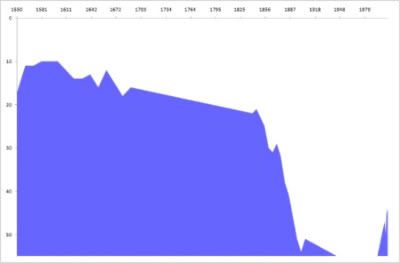
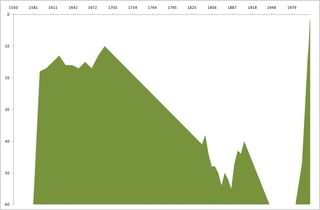
Let's just say, UK statistics from 1550-2007. Ranks. Graphs.

Grace:
Isabel:How to read the graphs:
Y (Left hand) axis = rank. #1 is most popular. If there is a gap then the name doesn't rank for that year. Lack of information for the early years means that I can't calculate % so the Mary graph is rather boring.
X axis = year. There are gaps in information from 1690-1840, and 1910-44 so that is why there are long straight joining lines between each.

They're not perfect. But they're decent, they're better than what there is already for the UK. And they make me happy.

Now, does anyone know where there are stats for the 1700s and interwar period?

Wednesday, March 25, 2009

One syllable names

One syllable names are somewhat useful - I suppose they are the names where you are really aware of their syllabic structure, they're short, generally snappy (though one could contest that statement with the lazy, drawn-out drawl of Charles or Blanche) and theoretically nickname-proof (though once again, Charles is an exception to the rule). They also tend to work well as middle names - many are of the the filler type eg Rose, Lynn, Ann, Grace and James. 


So here's a list, because it has been part of my 'Names' collection for a while, but I have not yet posted it:

Girls:
Anne Belle Blanche Blythe Brooke Clare Dawn Eve Faith Faye Fern Fleur Gail Grace Gwen Hope Jane Jill Joan Joy June Kate Liv Lux Lynn Maeve Maud May Mor Neve Niamh Noor Paz Pearl Rose Ruth Sian Tess Wynne

Boys:
Abe Bede Bjorn Blaise Bram Bran Bryn Cael Cai Carl Chaim Charles Cian Colm Dan Dean Drew Finn Ford George Giles Glen Grant Guy Heath Hugh Jack Jake James Jett Joel John Josh Juan Jude Klaus Kyle Lance Lars Leif Luke Mark Miles Neil Niles Noel Paul Paul Piers Quinn Rhys Sean Serge Seth Shane Tadhg Thor Yves Zane Ziv

Saturday, March 07, 2009

The Victorian Smiths - how realistic?

So I have acquired the top 20 for the 1881 census, and what do I want to do with it? Compare it with the Victorian Smiths of course!

If you want to know about censuses in the UK then there's a wikipedia page, and things on the Office for National Statistics and GENUKI. The 1881 census is the only one that is available completely free and can be searched on Family Search. The top 20 list that I have is from an article by Dr Kenneth Tucker published in Onoma, the actual article has a lot more information and analysis.


What does this mean? Well, the 1881 census includes pretty much everyone alive in 1881 - so they could be born in 1852 or 1820 or 1881 itself (as long as it's pre April), so I've added up all of the totals. Unfortunately, this excludes everyone born pre-1840 or born outside of UK. But as the life expectancy was lower than it is today (around 40-50 seems to be what I am finding) then this should affect it less than if it was studying the 2001 census where the life expectancy is longer. Also, there was an increase in population (14 mil to 24 mil 1840-80) that means that a significant proportion of the population will be under 40.

Anyway without further ado:
1881 census:

1

Mary

2

Elizabeth

3

Ann

4

Sarah

5

Jane

6

Ellen

7

Eliza

8

Alice

9

Annie

10

Emma

11

Margaret

12

Emily

13

Hannah

14

Martha

15

Louisa

16

Maria

17

Catherine

18

Harriet

19

Edith

20

Charlotte


Victorian Smiths 1840-80:

1

Mary

2

Elizabeth

3

Sarah

4

Ann

5

Alice

6

Jane

7

Emma

8

Ellen

9

Emily

10

Margaret

11

Annie

12

Hannah

13

Harriet

14

Eliza

15

Martha

16

Florence

17

Ada

18

Edith

19

Louisa

20

Clara


Mary, unsurprisingly, tops both lists with Elizabeth in second place. There is some shuffling around in #3 to 5 with Sarah, Ann and Alice in that order in the Victorian Smiths, while Ann, Sarah and Jane are in that order in the census list. Alice is #8 on the census, as Alice peaks in 1870s while Jane peaked in 1840s this probably represents that Jane was more popular pre-1840. 

Eliza similarly is in quite a different position - #7 in census, and #14 in Victorian Smiths. As Eliza peaked in 1850 and has a large fall (see 1850 graph), this probably means that there were more Elizas pre 1840.

Harriet is much higher on Victorian Smiths list - #13 compared with #18, this is another 1850 name so should really be the other way around. However, the 1850 graph shows that Harriet's popularity stayed fairly level from 1850 to 75 and started off lower, so this probably counts for its higher popularity on Victorian Smiths.

A few names on census list that aren't on Victorian Smiths top 20: Catherine, Charlotte and Maria. Starting with Maria, which peaked in 1840 and then fell fairly steadily throughout the period - that isn't really a surprise, and one wonders if Maria had actually peaked pre1840 and one of the limitations of the Victorian Smiths is only being able to go back to 1840. Catherine and Charlotte both peaked in 1870. In Catherine's case, there is an obvious growth to the 1870 peak, whereas Charlotte seems to have the same number of births throughout the period. Charlotte definitely feels like a Regency name to me, so that could account for its popularity. I am not sure whether in compiling the census list whether separate spellings were taken into account, for I think that is what decreased Catherine's share. 

A few names on the Victorians Smiths list that aren't on the census top 20: Ada, Clara and Florence. Ada and Clara are both names that peaked in the 1870s, and had very few births at the beginning of 1840s - their appearance shows the Victorian Smiths emphasis upon post-1840 popular names. Florence is #21 on the census list, and as I have written about a lot here, doesn't peak until 1895 when it dramatically ties with Mary. The Victorian Smiths is obviously foreshadowing such an event more than the census list.

If anyone has anything on the Victorian Smiths that they would like me to look into, then please post! If not, this may be the last post on the Victorian Smiths though I am thinking of using the data for a longer spanning project.

Monday, February 02, 2009

New Banner & Middle Names

Hurrah. Yes, I have a new banner. Am at university at the moment, so my output will be rather slow (hence no posts since Jan 1). So much snow here. 


I'm still poking around with the Telegraph/Times names lists, but here is the top 10 girls middle names (any position) for Telegraph:

1

Rose

101

2

Elizabeth

69

3

Grace

62

4

Mary

48

5

Jane

37

6

Alice

32

7

Charlotte

26

8

Louise

26

9

May

25

10

Ann

22


I'm surprised that Ann isn't higher (though Anne is #14, two spellings may have dented Ann's popularity a little) - it feels much more like a middle name to me than Charlotte. Still, this list proves that Rose reigns surpreme.

Times girls:

1

Rose

64

2

Elizabeth

41

3

Grace

33

4

Mary

33

5

Alice

23

6

Jane

18

7

Anne

17

8

May

17

9

Charlotte

16

10

Florence

13


Sorry for the strange spacing. Once again, Rose is #1. Alice & Jane have swapped places, while Anne is up in #7 (Ann is #12). Louise has dropped all the way down to #15, and so Florence (#12 Telegraph) is up to #10. There are fewer births in the Times list, so that accounts for the fewer middle names.

Number of middle names - Telegraph girls:

No. Of mns.

       %

4 mns

10

0.85

3 mns

333

28.34

2 mns

736

62.64

1 mn

96

8.17


2 mns are the most popular, but more than a quarter of Telegraph parents chose 3 mns.

Telegraph boys:

%

4 mns

16

1.256874

3 mns

540

42.41948

2 mns

624

49.01807

1 mn

93

7.305577

1273

 Two middles is also still the top for the boys, but the margin between 2 and 3 is not so large, as well as there being a larger % with 4 middle names. 


Thursday, January 01, 2009

Times and Telegraph Births

The complete list of first names is available here. I'll be adding middle names and other stuff later. 


Top 10 for each category:

Telegraph Boys:

1

William

77

2

Thomas

50

3

James

43

4

Oliver

42

5

Charles

41

6

Henry

41

7

George

37

8

Edward

35

9

Harry

33

10

Alexander

30


Telegraph girls:

1

Emily

30

2

Alice

26

3

Charlotte

26

4

Matilda

26

5

Olivia

25

6

Amelia

22

7

Isabella

21

8

Sophie

19

9

Daisy

18

10

Poppy

18


Times boys:

1

William

39

2

George

30

3

Edward

29

4

Henry

28

5

Alexander

26

6

James

26

7

Oliver

25

8

Charles

23

9

Thomas

23

10

Oscar

21


Times girls:

1

Emily

17

2

Isabella

16

3

Matilda

16

4

Olivia

16

5

Alice

15

6

Elizabeth

15

7

Sophie

15

8

Poppy

14

9

Charlotte

13

10

Imogen

13